

Give Samburu 3-4 nights for a considered stay, with time for game drives and the unhurried rhythm of the northern landscape. A Samburu safari package can also sit within a wider Kenya journey, with combined itineraries commonly running 7-10 days.
It makes sense to want time for wildlife viewing without spending the whole trip in transit. Pairing a Samburu safari package with another destination can broaden the journey, but the route and pace matter as much as the number of places on the map.
This guide covers how long to allow, how accommodation and budget choices affect a safari, which costs and inclusions to compare, and how Samburu can connect with other parks and reserves. Use these details to weigh a focused stay against a longer circuit, taking terrain and travel time into account.
Key Takeaways
- Allow a full day for wildlife viewing beyond the days spent travelling, so your time in the reserve isn’t reduced to a brief stop.
- Choose accommodation with the overall budget in mind: camp and lodge category can shape the cost as much as transport and activities.
- Compare what a safari includes, especially meals, transport and game drives, and account separately for park fees when they’re excluded.
- Consider Samburu, Buffalo Springs and Shaba for a northern Kenya circuit, with the route paced to leave time for game drives.
- For a wider itinerary, weigh the added destinations against the extra travel and decide which landscapes and wildlife experiences matter most to you.
Which other parks and reserves should I visit on a budget Samburu safari?
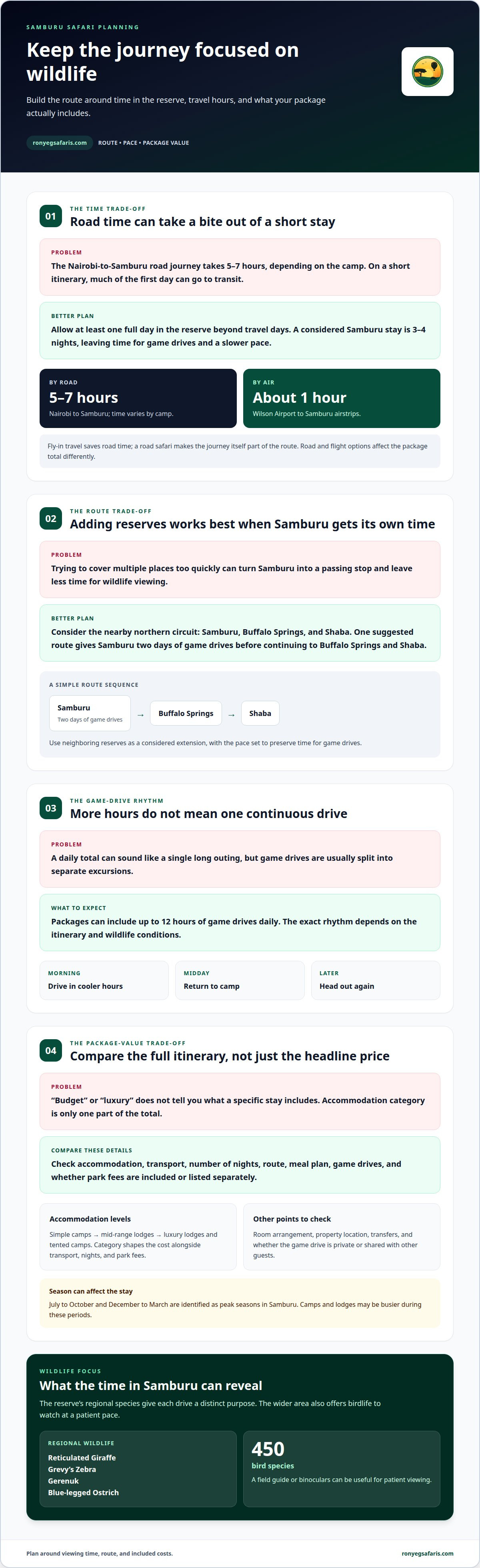
A budget Samburu safari package can combine wildlife viewing with nearby reserves instead of adding distant destinations. The Samburu safari area includes Samburu, Buffalo Springs, and Shaba. One suggested route allows two days for game drives in Samburu before continuing to Buffalo Springs and Shaba. This gives the main reserve dedicated time before the itinerary widens.
Game drives are the central activity across this northern circuit. The package can include up to 12 hours of game drives daily, though the day is usually divided into separate outings rather than one continuous drive. A typical schedule places a drive in the cooler morning hours, returns to camp around midday, then sets out again later. The exact rhythm depends on the itinerary and wildlife conditions.
Samburu’s wildlife gives each drive a distinct purpose. Look for Reticulated Giraffe, Grevy’s Zebra, Gerenuk, and the blue-legged Ostrich, identified as regional species. The wider area also has 450 bird species, making a field guide or binoculars useful for patient viewing. Buffalo Springs and Shaba extend the route into neighboring landscapes, while time in Samburu helps avoid turning the reserve into a passing stop.
Vehicle choice shapes both comfort and viewing. A 4x4 Land Cruiser is used for game drives and transfers, with a raised position that helps passengers scan open ground. The driver-guide handles navigation, reads tracks, and positions the vehicle for observation without crowding wildlife. Follow the guide’s instructions, remain seated during sightings, and keep voices low when animals are close.
Private safaris are available, but check the vehicle arrangement to see whether other guests share the drive. A private vehicle gives your party control over the pace, while shared arrangements include other travelers. The itinerary should state which applies. Pack neutral layers, a warm layer for early drives, a hat, sunglasses, sunscreen, binoculars, and a camera.
For health and safety, carry personal medication, drink water regularly, and use sun protection during open-vehicle drives. Keep your hands and belongings inside the vehicle near wildlife, and never approach or feed an animal. Follow the driver-guide’s directions at sightings and in camp. These habits help protect both travelers and wildlife.
Road travel also affects how much time remains for viewing. The drive from Nairobi to Samburu takes 5 to 7 hours, depending on the camp, so a short itinerary can lose much of its first day to transit. Allow a full day in the reserve beyond travel days, then use Buffalo Springs or Shaba as a considered extension rather than rushing between all three.
What type of accommodations can I expect on cheap Samburu packages?
Accommodation in Samburu ranges from simple camps to mid-range lodges and luxury tented camps. Your choice affects the overall safari cost, along with transport, nights, and park fees. A quoted price depends on the itinerary. Accommodation category, travel dates, route, and inclusions shape the total, so compare the full itinerary rather than just the type of bed.
Named examples in Samburu-area package listings include Samburu Simba Lodge, Sarova Shaba Game Lodge, and Elephant Bedroom Camp. These show that packages can use different properties and locations, including Shaba beyond Samburu National Reserve. A three-day itinerary with two nights leaves little room to change properties. Staying at one base can reduce transfers and keep the schedule straightforward.
Budget lodges and camps suit travelers who prioritize time outdoors over elaborate facilities. Mid-range lodges offer another level of comfort, while luxury lodges and tented camps sit at the higher end of accommodation choices. Labels such as “budget” and “luxury” don’t tell you what a particular stay includes. Check the stated meal plan, room arrangement, and location before comparing value.
Transport creates another clear difference. The road journey from Nairobi to Samburu takes 5 to 7 hours, depending on the camp. Domestic flights from Wilson Airport to Samburu airstrips take about 1 hour. A fly-in itinerary saves road time, while a road safari allows the journey itself to form part of the route. Flight and road options affect the package total differently.
Duration also changes the comparison. A three-day road safari includes two nights in the listed itinerary, while a longer journey can allow more time in the reserve. Fly-in options include itineraries lasting two, three, or four days. Compare nights and game-drive time as well as accommodation category. Travel takes up part of the schedule, even on a shorter stay.
Travel dates can influence accommodation demand and the feel of a stay. July to October and December to March are identified as peak seasons in Samburu. Camps and lodges may be busier during these periods, so consider how timing fits your priorities if you prefer fewer crowds. Season, property, and length of stay all influence the overall budget.
For a practical comparison, group options by road or air travel, then by lodging level and number of nights. Check whether the route covers Samburu alone or extends to Buffalo Springs or Shaba. This makes the trade-offs clear: a lower accommodation category, fewer transfers, or a longer stay may matter more than the lowest headline cost.
Budget Samburu safari package options
A budget itinerary starts with a clear choice: spend enough time in Samburu National Reserve for wildlife viewing, or add nearby places without rushing. Allow at least one full day in the reserve beyond travel days. A three-day road itinerary offers a practical starting point, while a longer stay leaves more room for game drives and a community visit.
Getting there from Nairobi is possible by road or air. The road journey takes 5 to 7 hours, depending on the camp, and suits travelers who want transfers by vehicle. Domestic flights from Wilson Airport to Samburu airstrips take about 1 hour. Compare the travel time with the length of your stay, since a short trip gives less time to recover travel hours through extra days in the reserve.
Road safari vehicle choices include a tour van or a 4x4 Land Cruiser. The vehicle affects the journey and the way the group views wildlife, while the itinerary determines how much time is spent on transfers. A Land Cruiser is suited to game drives and transfers in the region. For a budget plan, keeping the route focused on Samburu can reduce unnecessary driving between distant destinations.
Accommodation ranges from budget camps and lodges to mid-range properties. Choose based on location and schedule as well as comfort. A property near the planned game-drive area can help avoid extra transfer time, while two nights provide a straightforward base for a three-day visit. The listed Samburu Simba Lodge option has different rates, so room and travel details affect the total.
A safari quote depends on the itinerary. Lodging category, transport, season, and included activities shape the price. Compare the full arrangement rather than a headline figure. Check the number of nights and game-drive days, meals, vehicle type, and whether park fees are included. These details show what the budget must cover beyond accommodation.
A Maasai village visit can add a cultural experience to wildlife viewing. It fits best when the route and available time allow for the visit without displacing a full day in Samburu National Reserve. Including the activity in the itinerary helps coordinate its timing with road transfers, camp location, and game drives.
For a compact plan, keep Samburu as the main destination, select a budget camp or lodge, and allow a full reserve day beyond travel. Add Buffalo Springs or Shaba only if the route allows time for each stop. This makes the budget easier to assess: you can compare nights, vehicle, travel method, and activities before choosing a short stay or broader circuit.
Budget safari costs and inclusions
A Samburu itinerary’s total depends on travel style, accommodation, duration, and included services. Read the inclusions alongside the park-fee details to understand what the quoted amount covers.
Package Inclusions and Exclusions
A listed three-day safari includes two nights of accommodation and comprehensive game drives over three days. It also includes full-board meals, two bottles of water per person per day, transport in a luxury tour van or Land Cruiser, and pickup and drop-off in Nairobi. Park fees are excluded, so budget for them separately.
Check each item against the itinerary. Full board describes the meal arrangement, while the transport detail identifies the vehicle category. A tour van and a Land Cruiser are both listed options, and the route determines which transfers and drives are required. Check the written itinerary for the number of nights and game-drive days to distinguish travel time from wildlife-viewing time.
Park Fees and Conservation Charges
The listed Samburu National Reserve entry fee is US$70 per adult per day and US$40 per child per day. These park fees are excluded from the package, so include them separately when working out trip costs.
For a multi-day stay, the daily entry charge applies to each day covered by the listed fee. The total therefore depends on the number of adults and children and the days spent entering the reserve. Buffalo Springs and Shaba are separate reserves in the Samburu safari area. Don’t assume Samburu entry fees cover access to either one.
“Conservation charge” can refer to a cost associated with access to a reserve or conservancy, but the listed package details specify Samburu National Reserve entry fees. They don’t provide a separate conservation-charge amount. Keep the named charge distinct from accommodation, transport, and meals when reviewing the trip budget.
Other costs depend on itinerary choices, including accommodation category, road or air travel, and the route through the northern region. A tailor-made trip quote depends on the itinerary. The main cost factors are travel dates, duration, lodging, transport, and activities, rather than a universal package total.
Before setting a budget, separate included services from additional charges. Record the accommodation nights, transport arrangement, meal plan, game-drive schedule, and reserve entries. For example, park fees are outside the inclusions of a three-day itinerary with two nights. This breakdown makes the total easier to understand and avoids mistaking the package scope for every trip expense.
Combining Samburu with other destinations
Samburu can be the northern anchor of a longer Kenya itinerary, with other reserves adding contrasting landscapes and wildlife. Combined journeys commonly run 7-10 days. That span gives travelers room to connect destinations while preserving time for game viewing, rather than treating every stop as a brief transfer.
One clear pairing is Samburu with Laikipia. A listed Samburu and Laikipia safari itinerary lasts 6 nights and 7 days. This combination works for travelers who want to extend a northern wilderness stay without building a circuit around many distant stops. Consider how much time you want in Samburu first, then use the remaining days to shape the second destination into a meaningful part of the journey.
A broader route is the Samburu, Lewa and Mara North safari, listed at 9 nights and 10 days. The itinerary also identifies Masai Mara, Samburu, and Laikipia among its destinations. This gives a sense of the wider circuit: northern reserve landscapes can be joined with other wildlife areas, but each addition requires travel time. The number of destinations alone doesn’t show how much time remains for game drives.
To keep the route balanced, decide which experience matters most before adding stops. For example, travelers focused on Samburu wildlife may prefer fewer destinations and more time there. Those wanting a broader view of Kenya can consider a 7-10-day circuit, then weigh each destination against transfer time and planned activities. The central trade-off is clear: more places widen the journey, while fewer stops leave the itinerary less fragmented.
Season also shapes a multi-destination safari. Samburu’s listed dry-season periods are June to October and December to March. Aligning travel dates across destinations can help keep the route coherent, while each reserve brings its own setting and wildlife-viewing rhythm. Plan the sequence around the destinations you value most, rather than adding stops just to lengthen the route.
Before settling on a circuit, map the itinerary in order: identify the starting destination, list each reserve, then allocate nights and game-drive time. Check that the total trip length accommodates both the route and the experiences you want. A Samburu and Laikipia plan has a different pace from the 9-night, 10-day circuit, so choose based on priorities, not destination count.
For help shaping a route around Samburu and other Kenyan destinations, plan a multi-destination Kenya safari around your preferred pace and places.
Ronyeg Kenia Tours and Travels: Safari packages
Ronyeg Kenia Tours and Travels offers Safari & Tour Packages and tailor-made Kenya safaris for travelers planning a Samburu stay or broader route. If you’ve weighed travel time, reserve days, accommodation, and which destinations to combine, a thoughtfully arranged itinerary is the natural next step.
Share your preferred pace, travel dates, and whether Samburu should stand alone or connect with places such as Laikipia or Masai Mara. The itinerary can then be shaped around those priorities. Festive 2026/27 safaris and travel-trade ground partner services are also available for their respective travel needs.
For a Samburu route planned around your priorities, contact Ronyeg Kenia Tours and Travels.
Shape a journey that leaves room to see
The best route is not always the one with the most stops. Let the experience you value most guide the order: time among Samburu’s wildlife, a quieter stretch in another landscape, or a broader journey through Kenya. With that priority clear, a Samburu safari package can follow a considered pace rather than a hurried one.
As you plan, think beyond the map. A route is also a sequence of mornings, drives, and pauses, each affecting how closely you experience the land. Ronyeg Kenia Tours and Travels offers tailor-made Kenya safaris, festive 2026/27 safaris, and travel-trade ground partner services for different travel needs.
Take the next step with the places and pace you have in mind. Contact Ronyeg Kenia Tours and Travels to begin shaping your Kenya journey, and let the northern wilderness set its own measure.
Frequently Asked Questions
How many days is recommended for a Samburu trip?
Plan for 3-4 nights to give the visit a measured pace. If Samburu is your only destination, use the extra time for a fuller stay rather than adding unnecessary transfers. For a broader Kenya journey, decide which experience matters most before choosing the route. That priority helps determine whether to remain longer in the north or continue to another wildlife area.
How much does a Samburu budget trip cost?
The total depends on accommodation, transport, trip length, and included services. To plan your budget, decide first whether you prefer road or air travel, then choose a lodging level and route. A tailored journey is quoted based on those choices. Compare itineraries with the same dates and duration, since different inclusions can make headline amounts misleading.
What is included in a Samburu safari package?
Inclusions depend on the itinerary. A listed arrangement can cover lodging, meals, transport, and game drives, while reserve entry fees may be separate. Look for the specific vehicle, number of nights, pickup details, and meal plan in the trip description. Two itineraries of the same duration can differ in transport and park-fee treatment, changing what you need to budget for separately.
How much does a Samburu safari package cost per person?
There isn’t one fixed per-person amount because the itinerary, travel dates, lodging, and transport influence the quote. The planned route and included activities also affect the cost. Share your preferred dates and travel style when requesting a quote, then compare the itinerary’s inclusions and exclusions with another option. That makes the per-person figure easier to interpret.
What are the best Samburu safari lodges and camps?
A good choice depends on where the itinerary travels and your preferred comfort level. Samburu Simba Lodge, Sarova Shaba Game Lodge, and Elephant Bedroom Camp are named options in the area. Consider whether a property fits your route, meal arrangement, and planned drives. A stay in Shaba may suit an itinerary beyond Samburu National Reserve, while another camp may better fit a reserve-focused visit.
How many days should a Samburu safari package last?
A 3-day visit with 2 nights suits travelers seeking a compact itinerary; a 3-4-night stay allows a gentler pace. The best fit depends on how much time you want in the reserve and whether you’re continuing elsewhere. Choose the longer option if you want to avoid compressing arrival, wildlife viewing, and departure into a hurried sequence.
What wildlife can you see in Samburu National Reserve?
Wildlife sightings can include Reticulated Giraffe, Grevy’s Zebra, Gerenuk, and the blue-legged Ostrich. The surrounding Samburu region is also known for its birdlife, so binoculars can help you spot birds at a distance. Game drives follow changing conditions across the landscape, making patient observation valuable. Ask your guide about animal identification during the drive, especially when a sighting is brief.
When is the best time to visit Samburu for a safari?
June to October and December to March are Samburu’s identified dry-season periods. July to October and December to March are peak travel periods, while January, February, and June are rated good for visiting. Seasonal conditions vary, so choose dates based on your preferred travel experience. Choose dates according to your preferred seasonal feel and travel plans.


