

Budget, mid-range and luxury safaris in Kenya differ mainly in accommodation, transport, group arrangements, itinerary and included experiences. A Kenya safari ground partner coordinates these choices on the ground, so clear arrangements and reliable operations matter as much as the category attached to a trip.
A lower-cost option can still be thoughtfully planned, while a higher price should reflect meaningful differences in comfort, flexibility or logistics. Before choosing, understand what shapes the comparison and which style suits your journey.
This guide explains how to assess an operator’s reliability and compare budget, mid-range and luxury safaris without treating price as the only measure. It covers practical differences in accommodation, transport, group size and inclusions, helping you weigh comfort against your preferred way to travel. It also explains how a locally grounded partner can help shape a clear, tailored Kenya itinerary.
Key Takeaways
- Assess an operator by the clarity of its itinerary, local coordination and the practical details behind the quoted service.
- Compare budget, mid-range and luxury options by what shapes the experience, including accommodation, transport and itinerary design, rather than category labels alone.
- Understand how partner costs and commission arrangements are structured so you can plan transparent, workable travel-trade terms.
- Review payment, cancellation, refund, insurance and safety arrangements as part of the booking decision, not as afterthoughts.
- Consider how local knowledge and route planning differ across the Maasai Mara, Amboseli and Tsavo when matching a partner to your safari.
1. Choosing a reliable safari operator
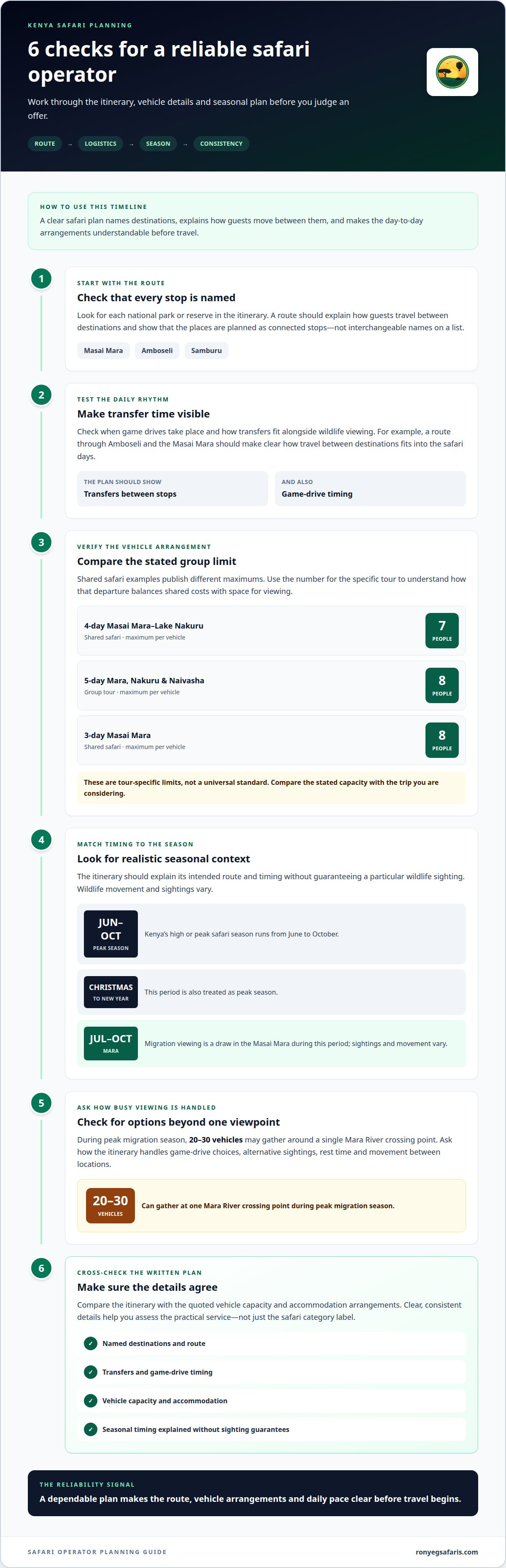
A reliable safari operator makes the route, vehicle arrangements and daily pace clear before travel begins. For a Kenya safari ground partner, local knowledge matters because wildlife movement, road conditions and lodge locations affect how an itinerary works in practice. A well-designed plan connects destinations with realistic travel days rather than treating the Masai Mara, Amboseli and Samburu as interchangeable stops.
Start by assessing the itinerary. Check that it names each national park or reserve, explains how guests travel between destinations and outlines when game drives take place. A route through Amboseli and the Masai Mara, for example, should show how transfer time fits alongside wildlife viewing. Flexibility also matters: local knowledge can help adapt a drive to wildlife movement while keeping the day’s arrangements clear.
Vehicle capacity is another practical measure. Shared safari examples in Kenya vary: a four-day Masai Mara-Lake Nakuru shared safari has a maximum of 7 people per vehicle, while a five-day Mara, Nakuru and Naivasha group tour allows up to 8. A three-day Masai Mara shared safari also lists a maximum of 8 people per vehicle. These are specific tour limits, not a universal standard. Use them to understand how a particular departure balances shared costs with room for viewing.
Let the season and destination guide your questions about the plan. Kenya’s high or peak safari season runs from June to October, and Christmas to New Year is also treated as peak season. In the Masai Mara, migration viewing is a draw from July to October, but wildlife sightings and movement vary. A sound itinerary explains the intended route and timing without promising a specific sighting.
Consider how the operator handles busy viewing areas. During peak migration season, 20-30 vehicles may gather around a single Mara River crossing point. This makes clear communication about game-drive choices and daily pacing more useful than a broad promise of exclusive viewing. Ask how the itinerary allows for alternative sightings, rest time and movement between locations.
Assess reliability through the detail and consistency of the plan. Compare the written itinerary with the quoted vehicle capacity, named destinations and accommodation arrangements. A Kenya safari operator should make these details clear, whether the journey focuses on elephants in Amboseli, the Masai Mara’s open plains or Samburu National Reserve. Clear logistics support a smoother safari across East Africa.
3. What shapes safari costs and commission terms in Kenya?
Safari budgets depend on the journey, not just its label. Accommodation, transport, destinations, season, group size and included activities all shape the total. A route focused on the Masai Mara differs from one combining several parks because distances, lodging and transfers change. The price depends on the itinerary and is provided after a quote request. A Kenya safari ground partner can help define these components in a clear plan.
For travel companies, distinguish the guest-facing trip price from the ground partner’s commercial terms. A net rate sets the amount payable to the operator, while a commission arrangement calculates the partner’s share under agreed terms. The agreement should state which model applies, what services it covers and how itinerary changes affect the calculation. This prevents either party from assuming a margin that the contract does not provide.
Commission arrangements depend on the agreed scope, included services and commercial terms. A ground arrangement covering transport, accommodation coordination and game drives differs from one covering fewer components. State which party handles each service, then define how commission is calculated and when it applies. Written terms make a working relationship with a Kenya safari ground partner easier to manage.
Build a like-for-like comparison before evaluating proposals. Record the accommodation level, transport type, route, park visits, activities and inclusions for each itinerary, then note exclusions and separately priced items. A lower headline amount may cover a different set of services, while another proposal may include more comfort or logistics. The comparison is useful only when each proposal addresses the same trip requirements.
For a travel-trade agreement, state the rate basis and payment flow in plain language. Specify whether amounts are net or commissionable, what the commission calculation uses and how amendments affect the agreed total. Include the currency and any conditions attached to the quote. These details give both parties a shared reference for bookings in the Masai Mara, Amboseli or elsewhere in Kenya.
Keep traveller expectations aligned with the written itinerary. If a route changes, explain how revised accommodation, transport or activities affect the quote and commission calculation. A clear record helps reconcile the guest price with partner terms without confusing service changes with commission. Travel companies exploring ground partner arrangements can use these points to frame a practical discussion about itinerary scope and commercial structure with a Kenya safari ground partner.
4. What are the payment terms, cancellation policies, and refund rules for Kenya safari partners?
For a travel company arranging a Kenya itinerary, put payment terms in the booking agreement before confirmation. Set out the payment schedule, currency, method and the point at which a booking becomes confirmed. For example, a Masai Mara itinerary should show which payment secures accommodation and transport and when any balance is due. The schedule should match the services being arranged.
Keep guest payments distinct from trade-partner payments. State who invoices the traveller, who pays the ground operator and how each payment is recorded against the booking. If a company bundles a safari with other arrangements, identify the services covered by each invoice. This avoids confusing a payment for a Tsavo game drive with accommodation or a separate transfer.
Cancellation terms should explain the process rather than rely on a broad phrase such as “standard policy.” Specify how a cancellation must be submitted, when it is treated as received and how any applicable charge is calculated. The agreement should also explain what happens when only part of a Kenya itinerary changes. Cancelling one night in Amboseli, for instance, may affect lodging and transport differently from cancelling the whole trip.
Refund terms should distinguish amounts that can be returned from costs already committed to suppliers. Explain how the calculation works, who communicates the outcome and how a refund is issued. For a booking combining the Masai Mara with another destination, state whether each service is assessed separately. Clear terms prevent travellers and trade partners from assuming every payment receives the same refund treatment.
Also cover changes that do not begin with a traveller’s cancellation request. If a route, accommodation arrangement or activity changes, explain how revised services affect the payment record and how any overpayment or additional amount is handled. Written approval of a change gives both parties a shared reference, especially when a company adjusts a multi-destination itinerary after confirmation.
Before accepting a booking, align the traveller-facing terms with the trade agreement. Confirm that the cancellation timeline, refund method and payment responsibilities are consistent, then use the same terms in the itinerary, invoice and booking confirmation. If a Samburu safari confirmation names a payment deadline, for example, the invoice and partner agreement should show the same deadline. This document-by-document check reduces disputes and clarifies what happens when plans change.
5. What insurance and safety standards should a Kenya safari ground partner meet?
Clarify insurance by activity, vehicle and responsible party. A travel company reviewing a Kenya safari ground partner can compare each part of a sample itinerary with the cover described in its agreement. For a road journey from Nairobi to the Masai Mara, identify who is responsible for vehicle-related cover, guest liability and medical response arrangements. These are separate questions, not one general assurance. The agreement should explain the scope, exclusions and claims process in plain language.
Keep traveller insurance distinct from the operator’s cover. A guest’s travel insurance may address personal medical needs or trip interruption, while an operator’s policies relate to its own activities and responsibilities. The protection depends on the policy wording. For a trip with road transfers and game drives, clarify which party’s policy applies to each service. Do not describe a policy as comprehensive unless its documented terms support that description.
For every vehicle-based safari, review practical safety arrangements alongside insurance. The itinerary should identify the transport type and explain how guests receive safety guidance before game drives. A useful operational brief covers remaining seated when instructed, following the guide’s directions and keeping a safe distance from wildlife. An elephant sighting in Amboseli is a practical example: guests need clear guidance on behaviour around animals, not a promise of a particular viewing.
Route planning matters too. A transfer between Nairobi and Samburu, for example, should account for the day’s driving and planned arrival so guests understand the sequence. The operator should explain who coordinates transport, who receives urgent reports and how itinerary changes are communicated to the group. Keep these responsibilities visible in trip documents, including the process for reporting an incident.
Review the documents before confirming a trade arrangement. Compare the itinerary, supplier agreement and insurance documents, then record any exclusions or responsibilities that affect the guest. Check the named insured party, covered activities, territorial scope, policy period and claims contact against the documents. If a plan adds a hot-air-balloon safari or Maasai village visit, make sure the activity description matches the documented arrangements. Do not assume one policy covers every component.
Finally, align safety communication with the itinerary. A guest travelling through Tsavo should receive relevant vehicle and wildlife guidance, while a walking activity needs its own instructions and responsible guide arrangements. Keep emergency contacts and incident-reporting steps accessible to the trip team. Sound planning connects insurance wording with actual operations, so each party understands its role before departure.
5. What are the best local ground partners for Maasai Mara, Amboseli, and Tsavo safaris
The right local partner is one whose operating strengths fit the route. A Masai Mara itinerary needs clear planning around reserve access, accommodation and game-drive timing. An Amboseli trip calls for a route shaped around the park and its landscape. Tsavo East and Tsavo West require their own itinerary choices rather than being treated as one interchangeable stop.
For the Masai Mara, look for an operator able to explain how the itinerary makes time for wildlife viewing and where guests stay. The reserve covers 1,510 km², so days on the ground benefit from a route planned around the chosen camp or lodge. During peak migration season, 20-30 vehicles may gather around a busy river crossing. A useful partner sets realistic expectations and plans game drives beyond a single anticipated sighting.
Amboseli National Park covers 392 km², and its open views give the journey a different character. Compare proposed routes by how they balance time in the park with transfers and accommodation arrangements. A partner should be able to explain the sequence of destinations and how the daily plan supports viewing. For example, a combined Mara and Amboseli itinerary should make clear how guests move between the two areas, not simply list both names.
Tsavo East and Tsavo West are separate destinations, so a strong itinerary states which park or parks it visits. It should show the order of travel and connect each overnight stop to the next day’s plans. For a route combining Tsavo with Amboseli, compare transfer arrangements and the time set aside for game drives. This distinguishes a carefully paced journey from one that names several parks without explaining how they fit together.
To compare local partners, assess each proposal against the same practical points: destinations, accommodation, transport, game-drive plans and who coordinates arrangements on the ground. Then consider whether the route suits the season and the traveller’s preferred pace. A company prioritising the Mara may need a different partner from one planning a longer Tsavo and Amboseli circuit. Clear, location-specific planning is more useful than a broad claim to serve all of Kenya.
For travel companies shaping a route through these regions, plan a tailored Kenya safari around the destinations and pace that suit your travellers.
Ask prospective operators to explain how local knowledge of parks and lodges, itinerary personalisation and flexibility around wildlife movement shape the proposal. These details show why route, duration and inclusions should be compared together.
Charter flights from Wilson Airport in Nairobi to airstrips in Kenya’s Masai Mara take approximately 45 minutes, so confirm whether air access suits the itinerary and how it affects time on the ground.
Ronyeg Kenia Tours and Travels: Travel-trade ground partner services
Ronyeg Kenia Tours and Travels provides travel-trade ground partner services for companies arranging journeys in Kenya. It plans and operates tailor-made safaris, with itineraries shaped around destinations such as the Masai Mara, Amboseli, Tsavo and Samburu.
Travel companies can work with the team on safari packages or tailor-made Kenya safaris, matching the route and pace to their travellers’ needs. Festive 2026/27 safaris are another option for clients planning Christmas or New Year travel. Clear itinerary details help partners align destination choices, accommodation arrangements and activities before presenting a trip to guests.
If your travel company needs a Kenya-based partner to plan and operate a safari itinerary, contact Ronyeg Kenia Tours and Travels to discuss your plans.
Shape the next itinerary around your travellers
Your next step is to turn your priorities into a clear partner brief. Set out the destinations your guests want to experience, their preferred pace and the level of comfort that suits them. Then discuss these choices with a Kenya safari ground partner, so the route is shaped around the journey rather than a category label.
For travel companies, a well-framed conversation can begin with a custom route, a seasonal departure, or the operational needs behind a ground partnership. Ronyeg Kenia Tours and Travels offers travel-trade ground partner services, tailor-made Kenya safaris and Festive 2026/27 safaris. Share the journey you have in mind and the needs it must serve.
Contact Ronyeg Kenia Tours and Travels to discuss your plans. A thoughtful beginning gives the journey room to take shape with care.
Frequently Asked Questions
What does a Kenya safari ground partner do?
A local ground partner coordinates in-country arrangements for a travel company’s safari, connecting the itinerary with operations and guest support. For example, a travel company can plan a route combining the Masai Mara with Diani, while its Kenyan partner coordinates the local safari arrangements. This role is distinct from selling international airfare or arranging standalone hotel bookings.
How to find a reliable Kenya safari ground operator or DMC?
Assess how a Kenya safari ground partner responds to a specific itinerary brief. Share the traveller profile, preferred destinations and travel pace, then look for a clear proposal that addresses those choices. A family seeking both wildlife and time on the coast, for instance, needs a route that connects those priorities. Specific planning and clearly described responsibilities are more useful than broad claims alone.
Which Kenya safari ground partners are licensed by the Tourism Regulatory Authority?
Assess licensing for the specific business entity rather than inferring it from a description such as DMC or ground operator. Compare the exact registered business name with current Tourism Regulatory Authority records and licensing evidence. This matters when a trading name differs from the registered entity. State that a partner is licensed only when the relevant records support the claim.
What questions should travel agents ask a Kenya ground partner before signing a contract?
Ask who coordinates each service, how itinerary changes are handled and who supports guests during the trip. Clarify the commercial model, cancellation terms, refund process, insurance scope and incident reporting. A Kenya safari ground partner should explain how these responsibilities apply to an actual booking, such as a Masai Mara trip with changed dates. Ensure the written agreement matches those answers and the traveller documents.


