

July to October is Kenya’s prime wildlife-viewing period and coincides with the Great Migration in the Maasai Mara. A Kenya safari itinerary for tour operators can focus on these months for migration-led trips, while January to March offers another dry-season window for wildlife viewing. The right dates depend on what your clients most want to experience.
Choosing dates is only the start. Route, pace, accommodation and time between parks all shape whether a safari feels rewarding or rushed, especially when clients have a set trip length or specific comfort preferences.
This guide explains how to plan around Kenya’s seasons, compare routes and durations, and assess accommodation and package inclusions. It also covers journeys through destinations such as the Maasai Mara, Amboseli, Tsavo and Samburu, with practical guidance on transfers and daily pace. Use it to match an itinerary to your clients’ priorities and present the package details clearly.
Key Takeaways
- Match travel dates to your clients’ priorities: July to October aligns with the Great Migration in the Maasai Mara, while other seasons shape a different safari experience.
- Build a route around the time available and the desired pace, rather than adding parks at the expense of time in the field.
- Consider Lake Naivasha and Hell’s Gate when planning a route that adds variety beyond traditional game drives.
- Compare package inclusions carefully, especially accommodation, transfers, meals, flights and activities, so the itinerary is clear from the outset.
- Use the package listings to identify which trip structure best fits your clients, then tailor the route and accommodation to their needs.
What type of accommodation can I expect?
Accommodation shapes a Kenya safari’s pace as much as its route. Match each stop to clients’ comfort preferences, schedule and interest in time on the plains.
Accommodation by Budget and Pace
Build the route around clients’ preferred accommodation style and pace, then choose suitable stops in destinations such as the Maasai Mara, Amboseli, Tsavo or Samburu. A slower itinerary allows more time in each place, while a multi-park route needs careful planning for transfers. For clients combining Kenya with Tanzania, include the cross-border journey in the schedule.
Comfort Levels and Lodge Stops
Accommodation ranges from simpler safari stays to high-end properties. Choose what fits the clients’ priorities and itinerary, and place lodge stops near the areas they plan to explore to avoid unnecessary transfers. In the Maasai Mara, for example, the lodge’s location affects how the day connects with time on the reserve’s open plains.
Nairobi arrival-day plans should allow time to settle into accommodation before adding activities. For clients with a full day in the city, Nairobi National Park covers 117 sq km and offers a nearby wildlife option. The Giraffe Centre is 20 kilometres outside central Nairobi, making it another possible stop. Choose activities around arrival timing and the clients’ energy after travel.
For a first night in Nairobi, choose accommodation to suit the next day’s departure. Clients heading toward Amboseli may prefer a simple arrival evening before the road journey; those travelling later can use the time for a city visit. Keeping the first day light leaves room for flight delays without squeezing planned safari time.
Season also affects where to place lodge nights. July to October is Kenya’s prime wildlife-viewing period and coincides with the Great Migration in the Maasai Mara. January through March is an uncrowded dry-season option for Big Five and predator viewing. Use these periods to shape the route, then match each accommodation stop to the experience clients value most.
For a Mara-focused journey, staying several nights in the same area can create a steadier rhythm than changing lodges daily. A broader itinerary might connect the Maasai Mara with Lake Naivasha or Amboseli, but every added stop requires time for travel and accommodation. Keep the plan realistic: fewer, well-placed lodge stops can preserve time for wildlife viewing.
When planning a Kenya safari itinerary for tour operators, treat accommodation, route and daily pace as connected decisions. Start with clients’ comfort preferences and arrival schedule, then assign lodge stops to the destinations they want to experience. This makes the plan easier to explain and gives each travel day a clear purpose.
Kenya safari itinerary options and trip durations
Trip length determines how much time clients have for wildlife viewing and how many stops fit comfortably. Build the route around their priorities and allow enough time for transfers between destinations.
Costs by Trip Style and Duration
Cost depends on trip length, accommodation, transport and whether the itinerary is private or shared. A focused Maasai Mara stay differs from a multi-park route, where extra destinations add transfers and accommodation nights. For a clear comparison, list the planned nights, lodges, game drives and included services for each option.
Starting Locations and Tour Duration
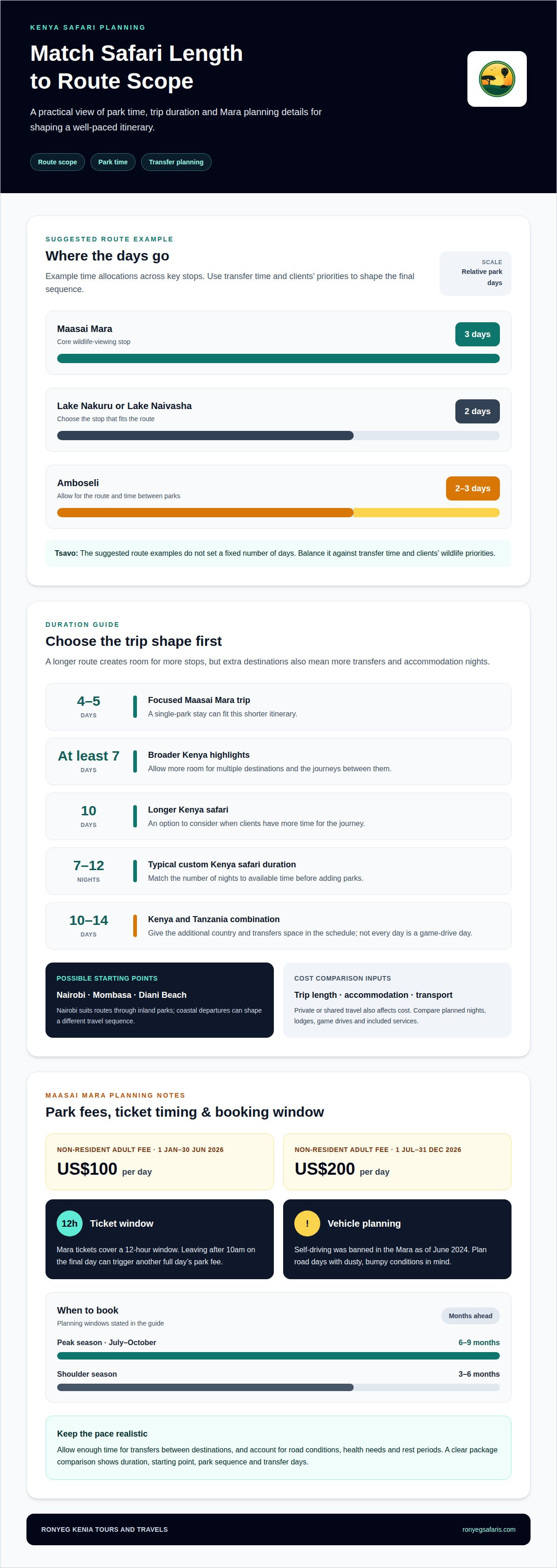
Kenya itineraries can start in Nairobi, Mombasa, or Diani Beach, among other locations. Starting in Nairobi suits routes through inland parks, while coastal departures can shape a different travel sequence. A single-park Maasai Mara trip can work in 4-5 days; allow at least 7 days for broader highlights, or consider 10 days for a longer safari.
For clients combining Kenya and Tanzania, plan around a 10-14-day route. The additional country means more transfers and destination choices, so operators should give travel days space rather than treating every day as a game-drive day. For a custom itinerary, 7 to 12 nights is a typical Kenya safari duration. Match the itinerary to clients’ available time before adding parks.
Park Time and Travel Considerations
For a suggested route, allocate 3 days to the Maasai Mara, 2 days to Lake Nakuru or Lake Naivasha, and 2-3 days to Amboseli. There is no fixed day allocation for Tsavo in the supplied route examples; balance it against transfer time and clients’ wildlife priorities. Maasai Mara non-resident adult fees are US$100 per day from 1 January through 30 June 2026, and US$200 per day from 1 July through 31 December 2026.
In the Maasai Mara, tickets cover a 12-hour window, and leaving after 10am on the final day can trigger another full day’s park fee. Self-driving was banned in the Mara as of June 2024. Plan road days with dusty, bumpy conditions in mind, and consider whether clients are comfortable entering and leaving safari vehicles. Keep health needs and rest periods in the itinerary rather than overloading each day.
Booking timing can shape which route and lodge combination is practical: July through October peak-season travel should be booked 6-9 months ahead, while shoulder-season travel usually needs 3-6 months. A concise package comparison should show duration, starting point, park sequence, and transfer days. For a route shaped around clients’ dates and priorities, explore tailor-made Kenya safari planning.
Lake Naivasha and Hell’s Gate options
Lake Naivasha and Hell’s Gate can add variety beyond time in the Maasai Mara. Compare private, shared, luxury and budget itineraries by group size, accommodation, transport, included activities and time at each stop, rather than relying on labels alone.
Hell’s Gate National Park covers 68.25 square kilometres, making it a distinct stop to consider alongside nearby Lake Naivasha. Together, they can break up a route focused on game drives and give clients a different landscape within the same safari. The best sequence depends on the rest of the itinerary and how much time clients want outside safari vehicles.
Pairing the Lake with Hell’s Gate
Combine Lake Naivasha and Hell’s Gate in an itinerary segment when clients want more than consecutive reserve visits. Hell’s Gate is a national park, while Naivasha adds a lake destination. Explain how transfers, overnight accommodation and time at each place fit into the wider journey. This clarifies the segment’s purpose instead of presenting it as an unexplained extra stop.
For private itineraries, explain how the schedule and vehicle arrangements suit the group’s preferred pace. Shared trips bring clients together in a vehicle and follow a set route, so describe the planned stops and activities clearly. Compare budget and luxury options by accommodation comfort, transport format and package inclusions. These practical details show clients the differences without relying on category names alone.
Optional Balloon Excursions
A hot-air-balloon safari is a separate option for clients whose plans include the Maasai Mara. Present it as an excursion distinct from regular game drives, and explain where it fits in the schedule. It may suit a migration-focused trip, but should not displace time clients have set aside for other wildlife experiences or destinations.
Make booking options easier to compare by describing each in the same order: route, accommodation, transport, included activities and optional experiences. For example, compare a private Lake Naivasha and Hell’s Gate segment with a shared itinerary using those same categories. Then state whether a Mara balloon excursion is included or optional. Consistent descriptions help travel sellers explain the differences and align expectations with the package.
Guides and vehicles shape each day, so identify the planned activity format and where clients meet the safari team. A reserve-focused itinerary emphasizes wildlife drives, while a Naivasha and Hell’s Gate segment offers a change of setting. Clients may also compare Kenya with Tanzania, so describe each destination’s role without implying that an excursion replaces another country’s migration experience.
Keep the final itinerary clear: name Lake Naivasha and Hell’s Gate as stops, distinguish included activities from optional ones, and show how the segment connects to the Maasai Mara or other destinations. This makes booking options easier to explain without filling the schedule with disconnected add-ons.
Included flights, transfers, hotels, and meals
A safari quote is easiest to compare when each inclusion is named and tied to the route. Nairobi, Amboseli, Samburu and the Maasai Mara each involve different transfer and overnight arrangements.
Start with transport. An itinerary may use road transfers, internal flights, or both; show which legs are covered and where each begins and ends. For example, the road journey from Nairobi to Talek Gate in the Maasai Mara takes roughly 6 hours. A flight can reduce time on the road, but the flight segment, baggage arrangements, and onward transfer should be clearly described.
Then map hotel and lodge nights against the travel schedule. A published seven-day format includes 5 nights in hotels and safari lodges, plus a day-use room on Day 7. This illustrates why the night count alone may not show the full accommodation plan. State where clients sleep each night, and identify any daytime room separately.
Meal details also deserve a clear breakdown. One package format includes 14 meals: 5 breakfasts, 5 lunches, and 4 dinners. Show the meal count and types in the itinerary, rather than using a broad phrase such as “meals included.” Clients can then understand which meals remain outside the schedule.
Compare Quotes by the Same Inclusions
Compare itinerary options side by side using the same categories: flights, road transfers, accommodation, meals, park entrance fees, guide services and game drives. Safari rates generally include lodging, meals, game drives, park entrance fees and guide services, but the package description should specify what applies to that route. A morning drive in a national reserve, for example, is different from a transfer between lodges.
- Flights: Name each internal flight leg and any connecting transfer.
- Transfers: Show the route, such as Lake Naivasha to Amboseli, which takes roughly 6 hours by road.
- Accommodation: List each hotel or lodge night and any day-use room.
- Meals: Give the meal count and indicate which meals are covered.
- Activities: Separate included game drives from optional experiences.
For a tailor-made safari, the price depends on route, accommodation, transport, meals and activities, and is provided after a quote request. This keeps comparisons fair: a Samburu itinerary with extra travel legs is not the same as a shorter stay in one reserve.
Show exclusions beside inclusions. Identify optional activities, meals outside the stated count and transport segments not covered by the package. Clear details help travel sellers explain what clients receive, from their first Nairobi transfer to their final lodge departure.
Kenya safari tour operators and package listings
A useful package listing shows more than a destination. Compare route, duration, accommodation, transport, activities and included services to see what each Kenya itinerary offers.
Season and route shape the experience. A migration-focused listing should name the reserve and explain how much time clients spend there. Other routes may pair Amboseli National Park, known for elephant viewing, with Lake Nakuru National Park or another destination.
Duration helps reveal whether a package is focused or broad. A single-park Maasai Mara safari can work as a 4-5 day trip. A suggested multi-park route sets aside 3 days for the Mara, 2 days for Lake Nakuru or Lake Naivasha, and 2-3 days for Amboseli. Longer Kenya and Tanzania journeys commonly need 10-14 days, allowing space for transfers between destinations.
Pay close attention to transport in each listing. State whether the route uses road transfers, a domestic flight or both, and show which legs are included. A flight can connect distant destinations, while a road itinerary offers a different rhythm and more time travelling overland. Make each journey’s start and end points clear, especially for clients arriving in Nairobi or starting at the coast.
Compare package descriptions using the same practical details:
- Route: Name each park or reserve and the order of stops.
- Duration: State trip days or nights, including time assigned to transfers.
- Stay: Explain accommodation level and where clients overnight.
- Activities: Separate scheduled game drives from optional excursions.
- Transport: Identify road and flight segments and their role in the route.
This format helps distinguish a shared budget journey from a private or higher-comfort itinerary without relying on labels alone. For example, two 7-day packages may visit different parks, use different transport, or allow different amounts of time for game drives. Show those distinctions plainly so clients can compare the experience, not just the trip length.
Permits, licenses, insurance and taxes relate to the operator’s business and applicable rules, not the itinerary alone. Describe travel arrangements and package inclusions separately, without implying that those details establish an operator’s compliance.
For a clear listing, connect each destination to a season, route and realistic duration. A Mara-focused migration journey differs from a circuit linking Nakuru and Amboseli. Make that distinction easy to see before booking.
Ronyeg Kenia Tours and Travels: Safari packages
Ronyeg Kenia Tours and Travels supports tour operators with safari packages, tailor-made Kenya safaris, and travel-trade ground partner services. Turn to its ground partner services when you need a Kenya-based operator to support the safari arrangements behind your client itinerary. For a route shaped around specific destinations, accommodation preferences, and pace, tailor-made safaris offer a flexible starting point. Festive 2026/27 safaris provide another option for clients planning Christmas or New Year travel. Each package can help you present a considered journey through Kenya, with the route and trip structure matched to the experience you intend to offer. Contact Ronyeg Kenia Tours and Travels to discuss your safari plans.
Turn Your Itinerary Plan Into a Clear Brief
Start by translating your clients’ priorities into a practical planning brief. Record their preferred travel period, pace, comfort expectations and main wildlife interests. Then note essential destinations and the experiences they consider central to the journey. These decisions give the itinerary direction before you arrange individual stops.
A Kenya safari itinerary for tour operators should make the proposed journey easy to explain. Set out the route, overnight sequence, transfer plan and purpose of each day. This helps clients see how the trip fits their interests and gives your team a clear basis for discussing adjustments.
Ronyeg Kenia Tours and Travels can support the next planning step with Kenya safari arrangements for travel-trade partners. Contact Ronyeg Kenia Tours and Travels to discuss the itinerary you’re shaping. With a thoughtful brief in hand, you can move toward a journey that feels considered from its first arrival to its final day.
Frequently Asked Questions
When is the best time to visit Kenya?
July to October suits clients hoping to connect their safari with the Great Migration in the Maasai Mara. January through March offers a dry-season alternative for clients prioritizing Big Five and predator viewing. April, May and November fall within Kenya’s green seasons and may suit travelers seeking a different landscape and travel period. Choose dates according to the experience clients value most, then shape the route around it.
How is the wildlife viewing?
Kenya’s destinations offer varied wildlife experiences, not one uniform viewing environment. Maasai Mara itineraries can focus on migration experiences and game drives, while Amboseli is known for elephant encounters. Tsavo East, Tsavo West and Samburu offer other regional options. Describe each area’s wildlife focus without promising sightings, so clients can choose destinations that match their interests and travel season.
How long should an African safari be?
For a Kenya-focused safari, 7 to 12 nights is a useful planning range for a custom itinerary. A 4-5 day trip can concentrate on the Maasai Mara, while a longer journey can include additional parks and allow more time between stops. Clients combining Kenya and Tanzania should consider 10-14 days for the broader route. Start with available travel days, then set a pace that leaves room for transfers.
What are the best Kenya safari itineraries for tour operators by trip length?
A 4-5 day itinerary can focus on the Maasai Mara. For a 7-day outline, one suggested allocation is 3 days in the Mara, 2 days at Lake Nakuru or Lake Naivasha, and 2-3 days in Amboseli. A 10-day plan allows a longer route or more time at selected stops. Present travel time alongside park nights so clients can compare the pace, not only the destination list.
Which Kenya national parks and reserves should a safari itinerary include?
Choose parks and reserves according to clients’ wildlife interests, preferred pace and route. The Maasai Mara, Amboseli, Tsavo East, Tsavo West, Samburu and Lake Nakuru offer distinct itinerary options, while Lake Naivasha adds a different setting. A Mara-focused trip suits clients prioritizing that reserve; a broader circuit can connect several regions. Explain why each stop belongs in the route rather than adding destinations without enough time to experience them.
What are typical Kenya safari package prices and park fees for tour operators?
Package costs depend on trip length, accommodation, transport, and included activities, so compare quotes using those elements rather than a headline rate. Maasai Mara admission also varies by visitor category and date. Maasai Mara admission fees may vary by age, so confirm the applicable rates when preparing a quote. Keep park admission separate from the package quote when presenting itinerary costs to clients.
When is the best season for Kenya safaris and the Great Migration?
July to October is the key period for migration-focused travel in the Maasai Mara. The wider migration cycle also includes southern Serengeti calving from December through February and northern Serengeti river crossings from July through October. For a Kenya-only itinerary, plan around the Mara experience clients want. For a Kenya and Tanzania journey, account for the relevant seasonal areas and transfer time.
How do tour operators arrange safari transport, domestic flights, and lodge transfers in Kenya?
Arrange transport as a connected sequence: arrival, transfer to the first overnight stay, travel between destinations, and the final departure connection. Use road or air itineraries according to the route and available travel time, then show which transfers are included. For example, a Nairobi-to-Maasai-Mara road leg takes roughly 6 hours. Kenya ground partners can coordinate local safari operations, including flights, hotels, and transfers within travel arrangements.


