

A low net rate is useful only when it’s clear what it covers and what you can add. Kenya safari net rates for agents are confidential trade prices from a ground operator. You set the traveller-facing price and build your margin into the sale, so the rate is only one part of the pricing decision.
It’s reasonable to want a quote that protects your margin and makes the costs clear to travellers. This guide explains how seasonal holds, park fees, inclusions, cancellation terms, and markups affect the final price, and what to check before using a quote in your safari proposal. You’ll have a practical framework for reviewing the commercial terms.
Key Takeaways
- Separate confidential net rates from commission-based pricing so you can see how your agency earns its margin.
- Plan peak-season requests early: Kenya’s July-to-October safari season coincides with migration, and agents are advised to book 6-9 months ahead.
- Assess quotes by their inclusions, especially park and conservancy fees, transfers, accommodation, and guiding.
- Read deposit, cancellation, and change terms alongside the quote, since they shape the financial risk of a booking.
- Set your markup with the full itinerary and the value of your planning work in view, rather than applying a percentage without context.
1. Confidential net rates and commission protection
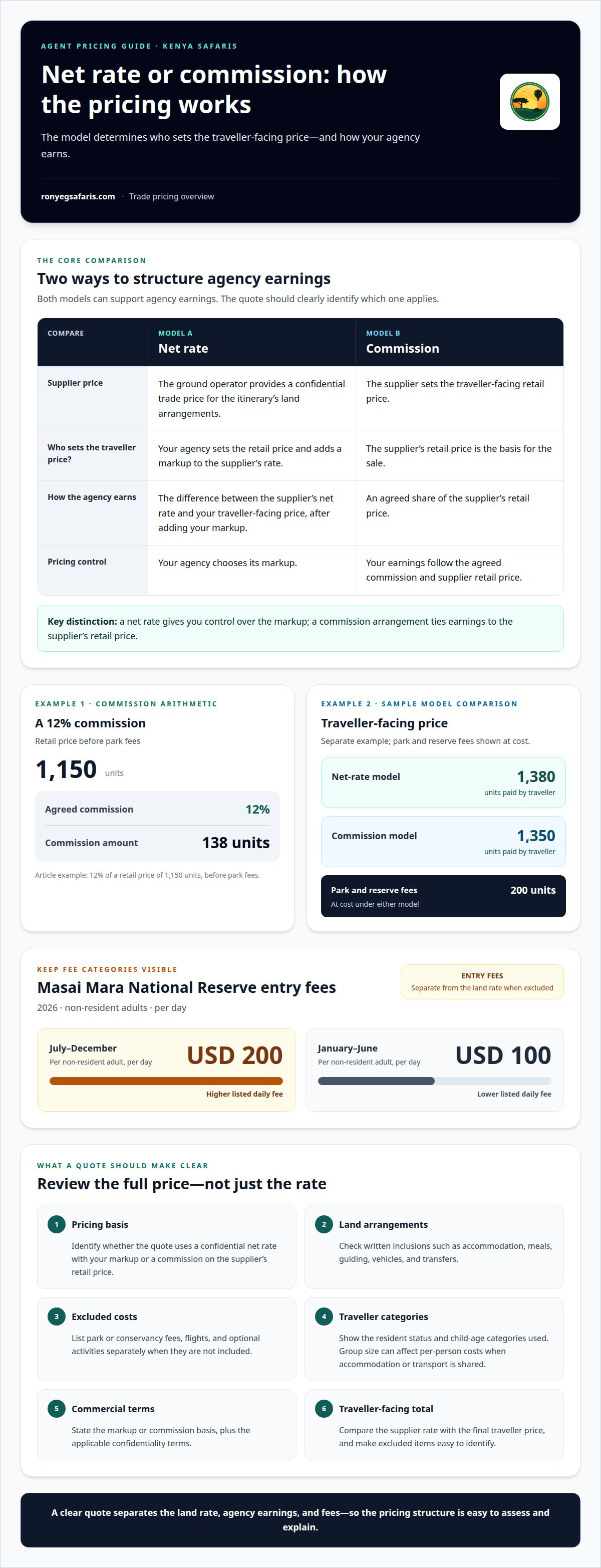
A net rate is the ground operator’s trade price for the land arrangements in an itinerary. You set the traveller-facing price, sometimes called the retail price, and retain the difference after adding your markup. Under a commission model, the supplier sets the retail price and pays you an agreed share. Either approach can support your agency’s earnings, but the quote should make clear which model applies.
What’s included depends on the itinerary and the supplier’s written inclusions. Accommodation, meals, guiding, vehicles and transfers may form part of the land rate; park or conservancy fees, flights and optional activities cost extra when excluded. In 2026, non-resident adults pay USD 200 per day to enter the Masai Mara National Reserve from July through December, and USD 100 per day from January through June.
Resident status, child age, and group size can affect a quote, but not always the operator’s net rate in the same way. Keep park-fee categories separate from the land rate, and show the traveller categories used. Group size can change per-person costs when accommodation or transport is shared.
A commission example shows the arithmetic. On a retail price of 1,150 units before park fees, a 12% commission equals 138 units. In a separate sample comparison, the traveller pays 1,380 units under a net-rate model and 1,350 units under a commission model; park and reserve fees are 200 units at cost under either model. These examples show why the pricing structure matters more than its label.
Trade rates and commissions depend on the agreement and package. A net rate lets you set your own markup, while a commission arrangement ties your earnings to the supplier’s retail price. Kenya safari net rates for agents should identify the itinerary, inclusions, excluded fees, markup or commission basis, and confidentiality terms. Compare the supplier’s rate with the traveller-facing total, then list excluded items separately. This protects your margin and makes the final price easier to explain.
2. Can you hold festive and migration-season allocations?
Kenya’s peak safari season runs from July through October, alongside the migration period. Agents are advised to book peak-season safaris 6-9 months ahead. That lead time gives an itinerary room to take shape before preferred camps, transfers, and conservancy stays become harder to coordinate. Festive dates also call for early planning, since accommodation and transport need to align across the same travel window.
A hold and a confirmed booking are separate stages. A hold temporarily reserves an allocation under the supplier’s terms; a booking is confirmed after the required payment and acceptance of those terms. Record the room type, travel dates, guest names, hold expiry, and payment deadline. This shows whether the whole itinerary is protected or only selected accommodation.
Booking through an agent gives travellers an itinerary shaped around their preferred pace, while booking directly puts them in contact with the local tour operator. A platform can help with initial comparisons, but its displayed package may not show every transfer, park fee, or conservancy stay equally clearly. Compare the same dates and inclusions across channels. A lower displayed total may simply exclude more components.
For example, an agent planning a July migration itinerary can request accommodation along the route and align transfers with each camp’s check-in dates. A direct booking can coordinate those elements too, but the traveller communicates itinerary changes with the operator. In either case, written terms should clarify the hold period, deposit schedule, cancellation rules, and change fees before the booking proceeds.
In-country coordination matters when an itinerary links Nairobi with remote camps or conservancy areas. A ground operator can coordinate accommodation, road or air transfers, and the order of activities. This operational view is useful when a late change affects multiple suppliers. For trade bookings, keep one itinerary record showing which elements are held, confirmed, or awaiting payment.
Hybrid planning can balance reach with local detail. An agent may use a platform to explore route ideas, then work directly with an operator on dates, transfers, and camp sequencing. The final quote should distinguish confirmed arrangements from temporary holds, rather than treating both as secured. For a Kenya itinerary that needs local coordination, Kenya safari planning can connect the route and ground arrangements within one plan.
3. Checking safari quotes for fair pricing
Compare quotes against the same itinerary, dates, and inclusions. For a Masai Mara package, match the number of nights, lodge standard, meal plan, vehicle arrangement, transfers, and activities. One quote’s headline total may look lower because it excludes an item included elsewhere. Put each quote in the same format before assessing its value.
Season affects the cost structure. Kenya’s shoulder season includes January-February and June; low season includes April-May and November. Peak season runs from July through October. Don’t compare a Masai Mara quote for August casually with one for April, since dates affect fees and accommodation arrangements. Match the dates first, then assess differences in lodging, route, and service.
Taxes, levies, and service charges should be clearly named in a Kenya safari quote. Clarify how park, reserve, and applicable conservancy fees are treated in each quote. State whether any applicable tax or service charge is included in the total or added separately. This helps you explain the final amount without presenting a fee as part of your markup.
Choose a pricing model that suits the way your agency sells travel. With a net-rate model, you receive a supplier price and set your traveller-facing markup. With a commission model, your earnings are an agreed share of the retail price. Compare the expected margin with the work involved in planning the itinerary, handling changes, and supporting travellers. A complex route with several lodges may call for a different approach from a straightforward package.
Give currency its own line in the quote review. Record the quote currency, the currency used for supplier payments, and how conversion is handled. Otherwise, exchange-rate movements can narrow your margin between confirmation and settlement. If you quote in your home-market currency, keep the Kenya ground costs separate from your markup in your working sheet. That makes changes easier to track.
Follow a consistent sequence: match travel dates, compare inclusions, separate park and conservancy charges, identify taxes and service charges, then review the currency and markup. Show Nairobi transfers, lodge nights, and conservancy stays separately in the itinerary costing. When a package changes, update the affected line rather than adjusting the total without explanation. This gives you a clear record of what changed and why.
4. Deposits, refunds, and cancellation risk
A safari deposit moves an itinerary from discussion toward confirmed arrangements. For travel agents, the written terms determine how that payment is applied if plans change. Kenya safari suppliers commonly require the balance payment 30 to 60 days before arrival, although terms vary by supplier and season. Build that deadline into the agency’s payment schedule, then align it with the traveller’s own due dates.
Before taking a deposit, record four points: the legal contracting party, the party receiving payment, the safari operator responsible on the ground, and the cancellation and change terms. These details matter when an agent works with a trade partner, local operator, and separate flight suppliers. Make sure the traveller understands who is responsible for each part before payment.
Refunds follow the written cancellation terms, not assumptions about what can be recovered. Permits, camps, and internal flights may be secured months in advance and can be difficult to resell at short notice. A cancellation can therefore leave committed supplier costs even when the traveller no longer takes the trip. The terms should explain how timing affects refunds and which arrangements have separate conditions.
For example, a family postponing an adventure safari may need new camp dates, revised transfers, and changed flights. Each supplier may handle date changes differently, so a general promise of flexibility does not describe the whole itinerary. Record which components you’ve asked to change, which costs remain committed, and what revised terms apply before accepting the new arrangements.
Reduce disputes by keeping the supplier’s terms alongside the traveller-facing booking conditions. Use the same itinerary version, travel dates, and lead traveller’s name on the quote, deposit record, and confirmation. If a camp or flight changes, update the documents together. This gives you, the traveller, and the ground partner a clear record of the agreed arrangements.
A practical sequence is straightforward. First, share the cancellation and change terms before collecting payment. Next, record the deposit deadline and the balance due 30 to 60 days before arrival. Then, issue confirmation that names the contracting party, payment recipient, and operator responsible on the ground. Finally, record any later change in writing, including its effect on camps, permits, transfers, or flights. Clear records make the financial consequences easier to explain.
5. Safari net rates and agency markups
A net rate gives an agency a base cost for the safari arrangements, with the agency setting its selling price. The markup is the amount added to that base; the margin is the share retained after relevant costs. For example, adding an 18% markup to 1,000 units of land arrangements earns 180 units before park fees. The traveller’s final price must still account for any excluded items.
Set your markup in line with the work and responsibility involved in each itinerary. A straightforward route may take less planning than a luxury journey with several lodges, specialist guides, and separate vehicles. Your time, payment handling, change management, and traveller support all contribute to the value you provide. Applying a percentage without accounting for that work can leave too little margin.
Examples help clarify the arithmetic, not dictate one universal rate. An agency might add 15% to a net rate, while a 10% markup may suit a product whose market supports less. Another comparison uses a 15-25% markup or service fee. These figures describe different pricing approaches, so define whether the agency’s amount is a percentage markup, a commission, or a separate fee.
Keep the calculation consistent. If the net land arrangements cost 1,000 units and the agency adds 15%, the selling amount becomes 1,150 units before excluded costs. If park fees sit outside the net rate, add them separately rather than applying the markup to them by accident. That distinction helps protect the agency’s intended earnings and makes the traveller-facing quote easier to explain.
Safari travel also carries costs beyond the operator’s arrangements. Guides, vehicles, accommodation, and transfers contribute to the underlying itinerary, while the agency’s margin pays for its own commercial work. A 10-day journey with multiple destinations may require more coordination than one lodge stay. Build the selling price from the actual scope, then record which components attract a markup and which pass through at cost.
Home-country safari agents typically add a margin of 15 to 30 percent above the ground operator’s rate. That range is a market reference, not a required formula for every package. A Kenya-based operator’s trade rate and an agency’s retail price serve different roles. Keep them distinct in the costing sheet, especially when revising dates, accommodation, or activities.
For a clear trade calculation, enter the operator’s net arrangements, identify excluded costs, apply the agency’s chosen markup, and compare the resulting total with the planned traveller price. Then review whether the margin still covers the itinerary’s planning and support demands. Discuss safari trade pricing for Kenya ground arrangements.
Ronyeg Kenia Tours and Travels: Safari packages
Ronyeg Kenia Tours and Travels helps travel professionals shape Kenya itineraries through travel-trade ground partner services. For a route that needs to reflect a traveller’s pace, interests, and chosen destinations, tailor-made Kenya safaris provide a practical starting point. Festive 2026/27 safaris suit agencies planning Christmas and New Year journeys.
Share the travel dates, guest requirements, preferred destinations, and trade-pricing structure needed for your proposal. These details help align the itinerary with the ground arrangements, so you can build a clear offer for your travellers. For a Kenya safari proposal or trade partnership discussion, contact Ronyeg Kenia Tours and Travels.
Build your next Kenya proposal with clarity
Strong Kenya safari pricing gives each part of the journey a clear place: the ground arrangements, your agency’s work, and the terms travellers accept. For your next proposal, shape the route around the guest and present the commercial details in clear language. A considered approach to Kenya safari net rates for agents supports a well-planned itinerary and a confident conversation with your traveller.
For agencies planning a tailored journey or festive departure, Ronyeg Kenia Tours and Travels can support the ground arrangements through its travel-trade services. Contact Ronyeg Kenia Tours and Travels to discuss the itinerary you’re preparing. With the practical terms settled, you can turn attention back to the country itself: open horizons, changing light, and the patient rhythm of the wild.
Frequently Asked Questions
What Are Safari Net Rates?
Safari net rates are confidential trade prices that ground operators provide to travel agents for safari arrangements. Use the rate to calculate your traveller-facing price and intended earnings. Depending on the agreement, you might add a markup or work under a commission structure. Compare the full itinerary cost, with inclusions and exclusions clearly separated.
Can you hold festive and migration-season allocations?
You can request allocation holds for festive and migration-season itineraries, subject to the supplier’s terms and requested arrangements. A hold is not a confirmed booking: its expiry and payment conditions determine how long the allocation stays reserved. For a Christmas departure combining camps and transfers, clarify which components the hold covers and whether supplier dates align before presenting the itinerary as secured.
Do you offer net rates to travel agents?
Yes. Ronyeg Kenia Tours and Travels offers confidential net rates to travel-trade partners through its ground partner services. Build proposals around local safari arrangements and apply your agreed retail pricing approach. For a useful trade enquiry, include the intended dates, route, accommodation preferences, and traveller requirements. This gives the discussion a specific itinerary to work from rather than an abstract request for a rate sheet.
What are current Kenya safari net rates for travel agents by season?
There is no single rate for every season and itinerary. Net pricing reflects the travel dates, route, selected accommodation, transport arrangements, park or conservancy charges, and inclusions. A Masai Mara stay and a multi-destination circuit have different costs. Request a tailored trade quotation from Ronyeg Kenia Tours and Travels based on the itinerary and its arrangements.
What are net rates for Kenya safari lodges, camps, and hotels?
Accommodation rates depend on the property, dates, room arrangement, and how the stay fits into the safari itinerary. For agents, a lodge or camp cost may be included within the overall ground arrangement rather than priced as a standalone accommodation booking. Compare equivalent dates and inclusions, then separate lodging from transport, guiding, and park-related charges. This shows what the trade rate covers across the safari.
What are the booking, deposit, cancellation, and payment rules for Kenya agent rates?
The supplier’s booking terms set the applicable rules, which can vary by arrangement and season. Before confirming a safari, align your traveller-facing conditions with the ground operator’s payment, cancellation, and change terms. Record who contracts with the traveller, who receives payment, and how amendments are handled. This is especially useful when accommodation, transfers, and internal flights come from separate suppliers.
How can travel agents request trade rates or access Kenya safari operator rate sheets?
Travel agents can request trade rates from Ronyeg Kenia Tours and Travels through its travel-trade ground partner services. Include the destination, travel dates, route, accommodation preferences, and required ground arrangements. An itinerary-based request frames the quotation around the actual trip rather than a generic rate sheet. Keep the resulting trade terms confidential when preparing proposals for travellers.
Which seasons and travel dates have supplements or minimum-stay requirements in Kenya?
Seasonal supplements and minimum-stay conditions apply to particular properties, destinations, and travel dates, not uniformly across Kenya. Festive dates or a stay near a migration-season route may have different supplier conditions. In your proposal, show any date-specific supplement or minimum stay beside the affected accommodation, then include its effect in the itinerary total before confirming the booking.


