

A balloon safari offers less control over your route than a vehicle game drive, but a wider view of the Mara as dawn reaches the plains. A Kenya hot air balloon safari is a dawn flight over the Maasai Mara, lasting about 75 minutes depending on the wind. From above, you can watch the landscape open beneath you, while the breeze, rather than a chosen destination, shapes the journey.
It’s natural to wonder whether an aerial view can match the closeness of a game drive. The two experiences reveal different sides of the reserve: a vehicle can follow tracks and pause near wildlife, while a balloon offers a broad perspective and a quieter sense of the land’s scale.
This guide explains what happens before and during the flight, what wildlife and scenery you may see, how wind shapes the route, and what follows landing, including breakfast when it’s part of the itinerary. It also compares the experience with a vehicle game drive, so you can understand what each adds to time in the Mara.
Key Takeaways
- Plan for an early start and dress for the cool morning air over the Mara.
- Let the wind set expectations: the flight route and landing place can vary.
- Find out how breakfast fits into the itinerary, since a bush meal may follow the flight.
- Look for a different perspective on wildlife and the landscape, not a guaranteed sighting or a close vehicle encounter.
- Shape your wider Kenya safari around the experiences that matter most to you.
What is a Hot Air Balloon Safari?
A Kenya hot air balloon safari is a dawn flight over the Maasai Mara, where wind shapes the route and the view unfolds from above. It offers a different perspective on the reserve from a vehicle game drive.
The Maasai Mara Balloon Experience
A balloon safari is an aerial journey over the Maasai Mara National Reserve, offering a broad view of its open plains and changing light. It matters because the elevated perspective reveals the scale and patterns of the landscape, rather than following one track through it. The horizon can feel wide in every direction, with a 360-degree view from the basket.
Flights take place at dawn, when the air is described as stable and temperatures are cool. A Maasai Mara flight lasts about 75 minutes, depending on the winds. From July through September, passengers may see the wildebeest migration from the air. Most flights stay close to the ground for wildlife viewing and photography.
Launch and Flight Experience
The launch begins before sunrise, with guests travelling to a launch site selected in relation to wind direction and wildlife in the area. The balloon rises as the pilot manages its height, sometimes reaching 1,000 feet (300 meters) on a Maasai Mara flight. The change in altitude shifts the view from ground-level detail to a wider sweep of the reserve.
The flight is typically planned as part of a Mara safari; how far ahead to book depends on the season and the wider itinerary. Because wind determines the direction, passengers can’t choose a destination or request stopovers. Weather may prevent a launch. If conditions cancel the flight, the balloon experience won’t take place, and the rest of the day follows the safari schedule.
Operator and Pilot Experience
Experience matters because a pilot must read wind and guide the balloon through a flight whose route cannot be fixed in advance. The pilot described in the Maasai Mara account began training there in 2007. That local training is part of the flight’s context, while the pilot’s decisions shape the balloon’s movement and height.
A balloon flight can’t be described as risk-free. Wind conditions and landing are practical risks to understand, so passengers need to listen to the pilot’s instructions during the experience. The route and landing place depend on the wind, and some flights end away from camp, with passengers returning by 4×4 safari vehicle.
The experience can suit travellers who value a wide landscape view and an unhurried dawn journey. Children generally need to be taller than 120 cm to join a Maasai Mara balloon safari. For families, that height requirement is a practical consideration when deciding whether the flight fits everyone’s plans.
Post-flight breakfast, champagne toast, and certificate
After landing, the morning may continue on the Mara plains with food and time to take in the experience. A bush breakfast may follow a Maasai Mara flight, depending on the itinerary.
The Post-Flight Bush Breakfast
A bush breakfast is a meal served outdoors after the balloon lands, bringing the flight to a quieter close. It can make the transition from the sky back to the day’s safari feel unhurried.
The setting is part of the appeal: breakfast takes place amid the open country, rather than in the balloon basket. The exact arrangement depends on the itinerary, so the meal isn’t a fixed feature of every flight. That distinction matters when planning the morning around other safari activities. Allow the schedule to account for the landing and breakfast before expecting to continue with the day’s plans.
Landing also shapes the practical flow. A balloon can finish away from camp, after which passengers return in a 4×4 safari vehicle. Breakfast arrangements fit around that return and the chosen itinerary. This is why the phrase “bush breakfast” describes a possible post-flight experience, not a promise that every landing happens beside a meal setting.
Champagne Toast and Certificate
A champagne toast marks the landing, while a participation certificate offers a keepsake of the flight. Together, they can bring the morning to a close beyond the view from the air.
The toast is a brief moment to mark the journey before guests settle into the rest of the day. A certificate can serve as a tangible reminder of flying over the Mara. In the described experience, the certificate was given by mid-morning, after the flight rather than during launch or landing.
These details distinguish the post-flight experience from the flight itself. The breakfast setting and the group’s return after landing still depend on the itinerary and landing location. Keeping the sequence in mind helps travellers understand how the morning may unfold without assuming every flight follows the same schedule.
A Kenya balloon safari package is planned around the flight, and a bush breakfast may follow, depending on the itinerary. The toast and certificate are post-flight elements, while the landing location determines the onward return.
For a wider Mara itinerary, a tailor-made Kenya safari can place the balloon experience within the shape of your days, including the time needed after landing. The key is to treat breakfast as part of the morning’s possible rhythm, not as a substitute for planning the rest of the safari.
Wildlife and Maasai villages seen from the air
From a balloon over the Maasai Mara, wildlife and human settlement form part of a broad view of the reserve. July through September is the period associated with migration viewing, when passengers may see wildebeest herds from the air.
Wildlife and Great Migration Viewing
Viewing wildlife from a balloon means observing animals and their surroundings from above, rather than following them along a track. This perspective shows how animals occupy the wider Mara landscape. From July through September, passengers may see the Great Migration, depending on where the herds are during the flight.
Maasai Mara balloon flights often travel close to the ground for wildlife viewing and photography. From this height, passengers can look for animals in open terrain while keeping the larger landscape in view. Unlike a vehicle following a sighting, the balloon follows the wind, not a particular animal.
For photography, changing distance affects what fits in the frame. A herd, a stretch of grassland, or a single animal against open country each offers a different composition. As the balloon moves, the angle can shift, so take time to observe the scene before photographing it.
Season matters most if seeing the migration is a priority. July through September is associated with possible aerial views of wildebeest herds. At other times, the Mara still offers wildlife and landscape from above, but the migration should not be treated as a feature of every flight.
Maasai Villages from Above
Views of Maasai villages from a balloon place settlements within the wider Mara landscape, rather than presenting them as isolated sights. The reserve is not only a wildlife setting, but also part of a lived region.
From above, a village may appear within a broader view of open land and human presence. The balloon’s route changes with the wind, so no particular village or viewpoint is guaranteed. This perspective invites observation without turning a community into a spectacle.
That wider view can deepen a traveller’s understanding of the Mara. Wildlife, grassland, and settlement share the landscape, though each flight presents them differently. A balloon offers distance and panorama, not the close, ground-level encounter of a vehicle visit.
To take in the view, notice how the scene changes as the balloon moves across the reserve. A Maasai village, a herd, and open plains each reveal a different part of the Mara, while the wind determines how they appear together.
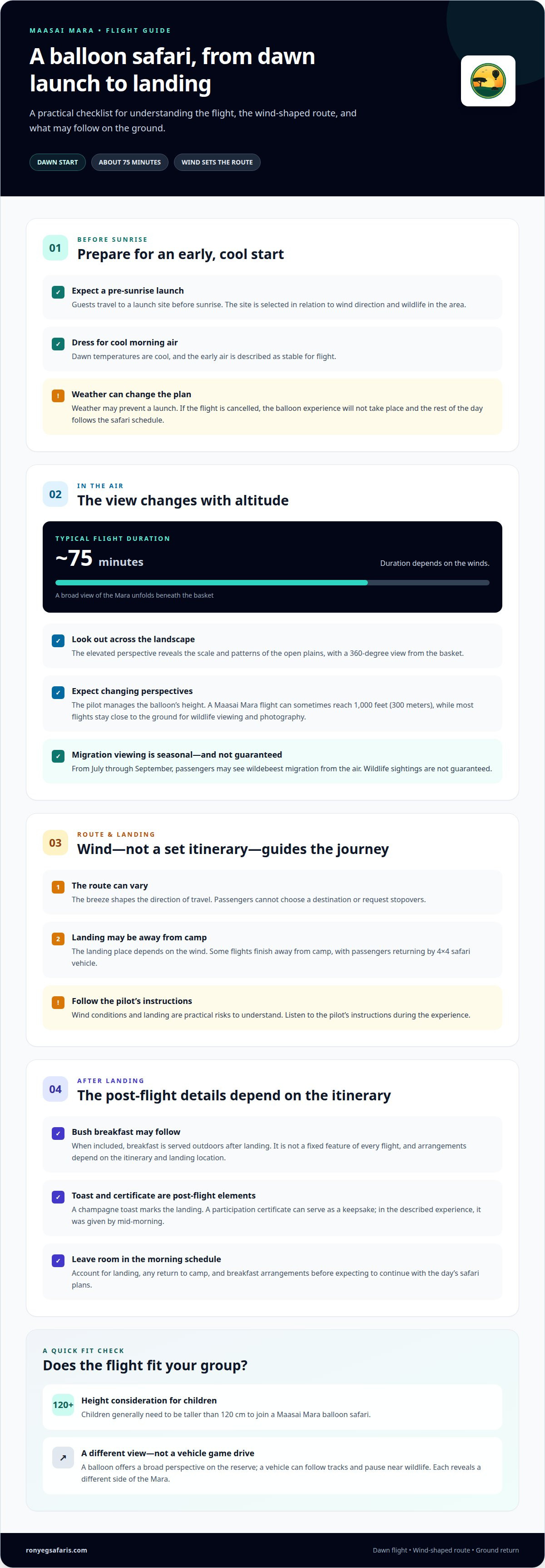
Changing wind direction and flight routes
Over the Maasai Mara, wind determines where a balloon travels, so the route is not a fixed circuit. Launch locations are chosen with wind direction and wildlife in the area at that time of year in mind. Each flight is shaped by the morning’s conditions, rather than taking passengers to a landmark of their choice.
This matters when deciding what you hope to see. Passengers can’t request a destination or ask the pilot to stop over a herd or viewpoint. The launch site is selected to suit the prevailing wind and local wildlife, but once airborne, the balloon still follows the air. The scenery appears as the route unfolds.
A Maasai Mara balloon flight lasts about 75 minutes, depending on the winds. Duration and distance are connected, but they aren’t interchangeable: a flight’s elapsed time doesn’t describe how far it travels across the reserve. The path depends on the wind’s direction and the launch and landing locations, so the route can’t be reduced to a set distance.
Landing is part of this wind-led journey. A balloon may finish away from camp, and passengers return in a 4×4 safari vehicle. The landing point is therefore not necessarily the launch point or the place guests expected to reach. That practical return by vehicle is part of the overall arrangement, not a stopover during the balloon flight.
Treat the balloon ride as a moving panorama, not transport between chosen places. A vehicle game drive can follow tracks and adjust its position near wildlife; a balloon cannot steer toward a sighting in the same way. Its view changes with the wind, revealing different stretches of the Mara during the flight.
There is no single useful measure of flight distance independent of route conditions. Wind direction, launch location, and landing place shape the distance covered. A longer flight doesn’t mean the balloon will reach a particular destination, and a visible landmark may remain out of reach. The pilot works with the route the wind allows.
When the wind carries the balloon away from camp, the ground crew’s role becomes visible after landing, as the 4×4 provides the return journey. This division between air travel and road transfer helps set clear expectations: the balloon offers a changing view, while the vehicle handles the journey back from the landing place. The route is part of the Mara experience, not a guaranteed itinerary.
How a balloon safari differs from a vehicle game drive
A balloon safari and a vehicle game drive show the Maasai Mara from different positions, with different kinds of control. The balloon offers a broad view from above, while a 4×4 travels across the ground and can adjust its route around wildlife sightings.
The wind carries the balloon, so passengers can’t choose a destination or request a stopover. The route may reveal herds, open plains, or a distant landmark, but the order and angle change with the air. A vehicle can respond to what its driver sees, making it better suited to following a particular sighting across the reserve.
The views differ just as clearly. From above, the Mara becomes a connected landscape, with wildlife set within wider patterns of grassland and movement. A vehicle gives passengers a ground-level perspective, where individual animals can fill more of the view. For example, a game drive after a balloon flight may bring travellers closer to a sighting such as a mother cheetah with three cubs.
Time also shapes the experience. A Maasai Mara balloon flight lasts about 75 minutes, depending on the wind, and begins at dawn. A vehicle game drive follows its own route and pace, so it can continue looking for wildlife after the balloon lands. If the balloon finishes away from camp, passengers return by 4×4 before the day’s ground activities continue.
Photography works differently in each setting. From a balloon, an animal and its surroundings can fit in one frame, especially during low flight. In a vehicle, passengers can turn toward a sighting and compose a closer, ground-level image. The balloon’s changing route may shift the view before a photograph is ready, while a vehicle offers more freedom to reposition.
Neither experience replaces the other. Choose a balloon for a moving panorama and the feeling of crossing the Mara from above. Choose a vehicle drive for a ground-level view and the ability to follow wildlife as it appears. Travellers with time for both can experience the reserve from two distinct vantage points during the same safari.
For a journey that gives both experiences room, include them in a tailor-made Kenya safari. The sequence can shape how the morning unfolds, with the flight’s landing and return by vehicle considered alongside the rest of the game drive.
Ronyeg Kenia Tours and Travels: Tailor-made Kenya safaris
Ronyeg Kenia Tours and Travels plans tailor-made Kenya safaris around travellers’ priorities. If you want both a balloon flight and ground-level wildlife viewing, a tailored itinerary can make space for each experience and account for breakfast and the return after landing.
Safari packages offer another way to plan time in Kenya, while festive 2026/27 safaris suit travel planned for that season. The right fit depends on how you want to balance the Mara with the rest of your journey. Share the experiences you value, and the itinerary can be shaped around them.
Contact Ronyeg Kenia Tours and Travels to discuss a tailor-made Kenya safari.
Let the Mara Shape Your Next Journey
A Kenya hot air balloon safari can be a defining part of a wider journey, but a thoughtful itinerary leaves room for the experiences you want around it. Consider whether you’d prefer a quieter pace in the Mara, more time for ground-level wildlife viewing, or a route that continues beyond the reserve. These priorities give your plans a meaningful starting point.
Ronyeg Kenia Tours and Travels offers tailor-made Kenya safaris, Festive 2026/27 safaris, and travel-trade ground partner services. These options serve different needs, from shaping a personal trip to supporting travel-trade arrangements. The next step is simply to share the journey you have in mind and the experiences you want it to hold.
Contact Ronyeg Kenia Tours and Travels to discuss your plans. Let the Mara be the beginning of a journey shaped with care and purpose.
Frequently Asked Questions
How Much Does It Cost and Is It Worth It?
The value depends on what you want from your time in the Mara. A balloon flight offers a landscape-wide perspective and a quiet experience above the plains, while a vehicle drive suits travellers seeking ground-level wildlife viewing. The price depends on the case and is given after a quote request; itinerary, season, and included arrangements shape the cost. Consider whether the aerial view adds something meaningful to your safari plans.
Is There an Age Limit for Children?
The practical child-related threshold is height: children generally need to be taller than 120 cm to join a Maasai Mara balloon safari. That’s a height measure, not a fixed age, so children of the same age may differ in whether they meet it. For family planning, use each child’s height rather than age alone when considering whether the flight suits your group.
What Makes These Trips Different?
The main difference is the vantage point: a balloon carries passengers above the reserve, while a vehicle travels across it. Basket layout also shapes the shared experience. One Maasai Mara basket described for a flight had five sections and accommodated 16 guests, with four passengers in each passenger section. This gives a sense of how passengers may be arranged during a group flight.
Where Can You Take a Hot Air Balloon Safari in Kenya?
The Maasai Mara National Reserve is a well-known setting for balloon flights, and balloon safaris are also described in Amboseli. Each landscape offers a distinct view and can shape the wider safari you’re planning. The Mara is associated with open plains and migration viewing, while Amboseli has its own setting beneath Mount Kilimanjaro. Choose the destination that best fits your broader Kenya itinerary.
How Much Does a Hot Air Balloon Safari in Kenya Cost?
The itinerary, season, and arrangements included shape the cost, so the price for one journey won’t necessarily describe another. Travellers planning from the United States can first decide how a balloon flight fits into their wider Kenya safari, then request a quote based on that plan.
How Long Does a Balloon Safari Last, and What Is the Itinerary?
A Maasai Mara flight lasts about 75 minutes, depending on the wind. The outing begins before sunrise and includes travel to the launch site, followed by the flight and a return from the landing area. A bush breakfast may follow, depending on the itinerary. Leave room in your morning plans for those connected parts, rather than treating the flight duration as the full outing.
What Wildlife Can You See on a Maasai Mara Balloon Safari?
Wildlife sightings vary with the route and the animals present in the area. Passengers may see wildebeest from the air during the migration period, and a low flight can offer views suited to wildlife photography. A balloon provides a broad view of animals within the landscape; it doesn’t follow a particular sighting like a vehicle can. Treat each view as part of a changing aerial perspective.
What Are the Age, Height, and Health Requirements for Balloon Passengers?
For children, the general height threshold is taller than 120 cm; this is not expressed as a specific age limit. Height is therefore more useful than age when considering whether a child meets the stated criterion. No general health threshold is provided here, so avoid assuming that age or height alone describes every passenger’s circumstances. The flight also requires passengers to follow the pilot’s instructions.


