

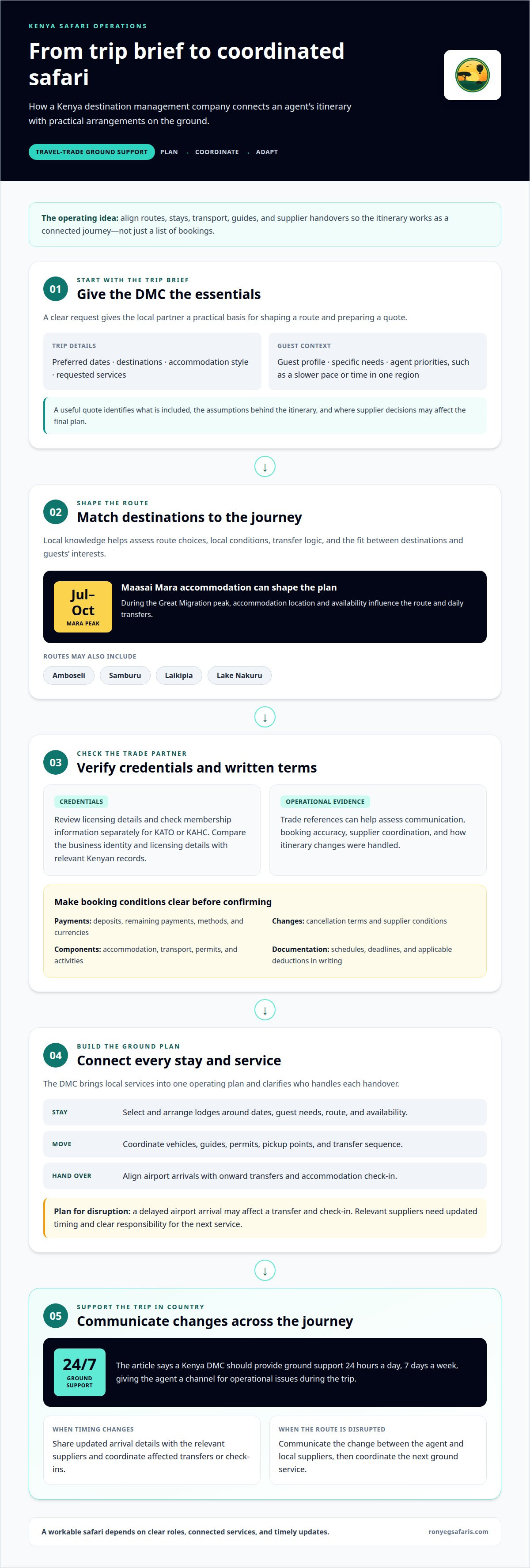
A Kenya DMC for travel agents connects a thoughtfully planned safari with the local arrangements that bring it to life. It coordinates services such as transport, guides, and accommodation, drawing on local knowledge of Kenya’s regions and safari conditions. This expertise helps agents make practical choices about routes, seasons, and guest needs.
Travel agents already know that a well-designed itinerary needs more than a sequence of destinations. It needs sound coordination and a trusted local partner who understands how the details fit together. This guide explains what a Kenya DMC does, how ground support can help agents and tour operators plan and manage safaris, and what to consider when choosing a trade partner. It also outlines how local safari knowledge can shape routes across Kenya, from the Maasai Mara to destinations such as Amboseli, Samburu, and Laikipia.
Key Takeaways
- See how local coordination of vehicles, guides, lodge arrangements, and contingency plans can help keep a safari itinerary workable on the ground.
- Understand how a DMC’s regional knowledge can shape routes beyond the Maasai Mara, including Amboseli, Samburu, Laikipia, and Lake Nakuru.
- Learn which operational details matter when planning support for international guests, from accommodation arrangements to resolving changes during a trip.
- Explore how clear roles and communication can help travel agents build practical, lasting trade partnerships with a Kenya-based ground partner.
- Identify when travel-trade ground support, tailor-made safaris, or safari packages may suit the needs of your itinerary and guests.
Looking for a Trusted B2B B2B Travel Agents in Kenya?
A destination management company connects an itinerary with the people and arrangements needed on the ground. For travel agents, accommodation and logistics should align with each route, arrival, and guest requirement.
Accommodation and Ground Logistics
Accommodation coordination covers selecting and arranging lodges around the itinerary, travel dates, guest needs, and route. Direct lodge relationships can support allocations and help resolve booking issues. For a Maasai Mara itinerary during the Great Migration’s July through October peak, accommodation location and availability influence the route and daily transfers.
Ground logistics connect each stay with the next part of the journey. A DMC can coordinate vehicles, guides, permits, and contingency planning, then align airport arrivals with onward transfers. Look for clear details about pickup points, transfer sequence, accommodation, and who manages changes. These practical arrangements turn a list of bookings into a workable safari plan.
Supplier Coordination and Ground Handling
Ground handling means coordinating the local services that carry guests through an itinerary. A destination management company brings transport, guides, accommodation, and permit arrangements into one operating plan. For example, a delayed airport arrival may affect a transfer and check-in, so coordination helps relevant suppliers receive updated timing.
Supplier coordination also matters when an itinerary crosses several regions. Kenya routes may include Lake Nakuru, Amboseli, Laikipia, or Samburu, each requiring arrangements that fit the planned stops. Look for a clear sequence of responsibilities: who shares arrival details, who communicates a change, and who coordinates the next ground service. Defined handovers reduce gaps between suppliers.
Licensing, Accreditation, and Reputation
To assess a DMC, review its licensing details and look for membership in the Kenya Association of Tour Operators (KATO) or the Kenya Association of Hotelkeepers and Caterers (KAHC). Licensing and membership are separate checks. Review the organisation’s membership information and compare its business identity and licensing details with relevant Kenyan records.
Consider reputation alongside operational evidence. Trade references can describe communication, booking accuracy, and how a company handled itinerary changes. Ask about supplier coordination across accommodation, transport, and guiding. Consistent, practical examples offer a clearer picture than broad claims about destination management.
Booking and Payment Terms
Booking terms explain how a reservation is confirmed, when deposits and remaining payments are due, and which payment methods and currencies apply. Cancellation terms set out the consequences of changing or cancelling a booking, including how supplier conditions affect the itinerary. Review these provisions in the written agreement before confirming arrangements for guests.
Review each term against the trip’s structure. Accommodation, transport, permits, and activities may involve different suppliers and conditions, so the agreement should explain how changes affect each component. Keep payment schedules, cancellation deadlines, and applicable deductions clearly documented. This gives agents a practical basis for managing client expectations and ground arrangements.
DMC support for international travel agents and tour operators
For international agents, a DMC connects itinerary planning with local arrangements and in-country support. Assess how clearly those services fit the guests’ route and the agent’s responsibilities.
Quotes and In-Country Support
A useful quote request outlines the route, travel dates, accommodation preferences, guest needs, and requested services. The number of arrangements involved, including accommodation and ground transport, shapes the proposal. A clear quote identifies what is included, the assumptions behind the itinerary, and where supplier decisions may affect the final plan.
Once guests are travelling, in-country support helps coordinate changes between the agent and local suppliers. A Kenya DMC should provide ground support 24 hours a day, 7 days a week. This means the agent has a channel for operational issues across the trip, from a changed arrival time to a disruption affecting the next transfer.
Local Expertise, Service, and Fleet
Compare DMCs by how clearly they explain route choices, local conditions, and the practical fit between each destination and guests’ interests. Good service also means clear communication with the agent and coordination with local suppliers. Vehicle arrangements should suit the itinerary, passenger needs, and planned ground travel.
Assess these differences through sample itineraries, explanations of vehicle arrangements, and examples of how changes are handled. A DMC that works with travel-trade partners can support international agents and tour operators. Health, weather, and seasonal considerations depend on the route and travel dates, so account for local conditions when planning.
Custom Itinerary and Quote Requests
A useful quote request gives the DMC the trip’s essential details: preferred dates, guest profile, destinations, accommodation style, and requested services. Include the agent’s priorities, such as a slower pace or time in a particular region. This gives the DMC a clear basis for shaping the route and coordinating arrangements.
For a custom itinerary, review the proposed sequence of destinations, transfer logic, accommodation choices, and included ground services together. This makes it easier to spot a tight connection or a mismatch between the guest’s priorities and the route. A locally planned Kenya itinerary can give agents a starting point for discussing those choices.
Marketing materials and inquiry support help agents present the destination consistently. Useful materials describe the itinerary, accommodation, and planned experiences in language that can be adapted for a client proposal. Travel document guidance should clarify which trip details guests need to prepare, while emergency support should focus on communicating operational changes and coordinating the relevant local response.
Trade partnerships for international travel agents
A sound trade partnership defines how a local operator supports the agent’s itinerary and client relationship. Clear roles help both sides coordinate proposals, promotions, and trip arrangements.
B2B Partnership Arrangements
A B2B agreement should explain who manages itinerary changes, supplier communication, and guest updates. It should also set out how the agent and destination partner share trip information before arrival. For a wildlife itinerary in the Maasai Mara, for example, agents need consistent details about accommodation, guides, and planned activities.
Discuss how requests move between the agent and local team, including who handles revised dates or guest preferences. Defined communication channels and responsibilities make collaboration easier across time zones. The partner’s role should complement the agent’s client service, with clear ownership of each communication and decision.
Partner marketing materials can help agents present Kenya with accurate, useful detail. Agree how itinerary descriptions, destination information, and images are shared and adapted for client proposals. Materials should reflect the actual route and accommodation, rather than promise experiences the itinerary does not include. For example, a proposal featuring Maasai Mara wildlife viewing should match the planned stay and guiding arrangements.
Partner Pricing and Onboarding
Local pricing reflects the services and suppliers selected for a particular itinerary. Partner pricing should make commercial terms clear, including inclusions, exclusions, and applicable supplier conditions. Review how accommodation, ground services, and requested activities shape the proposal instead of relying on a broad package label.
Onboarding can establish how agents submit enquiries, receive itinerary proposals, and communicate guest preferences. It should explain how revisions are handled and how final trip details are shared. A written process helps agents know what information to provide and what to expect in the proposed arrangements.
Promotions work best when the partner and agent agree on the audience, itinerary, and timing before publishing. A seasonal campaign can describe a Kenya safari route and its accommodation style without promising wildlife sightings. Keep wording consistent across the agent’s proposal and the destination partner’s materials, so clients receive a clear, coherent account.
Before beginning a trade relationship, map the practical steps: enquiry, proposal, revisions, confirmation, and pre-trip communication. Record who owns each handover and how changes reach the relevant team. This workflow helps agents manage client expectations while local partners coordinate the arrangements behind the journey.
Connecting travel agents with local DMCs in Kenya
A local DMC bridges the distance between an overseas sales desk and Kenya’s ground arrangements. A strong partnership starts with a shared programme, clear responsibilities, and a practical way to get information to the people delivering each service.
Start by matching the agent’s working style with the DMC’s trade process. Agree how enquiries are submitted, which details shape a proposal, and how revisions are recorded. For example, an agent selling a wildlife-focused journey can share guest interests, preferred pace, and accommodation style. The local team can use this brief to build an itinerary around the guests, rather than defaulting to a generic route.
Map the handovers between the overseas office and Kenya-based operations. A useful working plan identifies who communicates itinerary changes, who updates the guest, and how local suppliers receive revised information. This matters when a flight change affects an airport transfer or accommodation arrival. Clear ownership helps prevent messages from getting lost between the agent, DMC, and supplier.
- Share the brief: provide travel dates, guest profile, priorities, and requested services.
- Shape the programme: discuss route, pace, accommodation preferences, and local arrangements.
- Agree communication: set the channel for updates and identify who relays decisions.
- Prepare the handover: keep final itinerary details consistent for the agent and ground team.
Geography also influences the partnership. A DMC based in Nairobi can connect an arrival in the capital with onward travel. A day or two in Nairobi before or after a safari can also give a programme more breathing room. The best sequence depends on arrival timing, destinations, and how the agent wants guests to experience the journey.
Agents can build regional knowledge into the relationship over time. Use post-trip feedback to see where the programme met guest expectations and where communication could improve. If clients found a transfer tiring, review the route sequence and overnight stops together. Each completed journey can then inform future planning.
Treat the DMC as a working partner, not simply a name attached to an itinerary. Define the brief, agree on handovers, and keep the programme aligned from proposal through travel. With these foundations, local knowledge can support the agent’s client relationship while keeping Kenya’s landscapes at the heart of the experience.
What does a Kenya destination management company (DMC) offer travel agents?
A Kenya DMC turns an agent’s trip brief into locally coordinated arrangements. This can include route planning, accommodation, guides, vehicles, permits, and supplier communication. The value lies in joining these elements into a practical programme rather than leaving the agent to coordinate each local service separately.
For example, an agent planning a safari can shape the route around guest interests, travel dates, and preferred pace. Kenya options include the Maasai Mara, Amboseli, Lake Nakuru, Laikipia, and Samburu. Each destination changes the route and the arrangements required. The DMC helps connect those choices with suitable stays and ground services, while the agent remains the guest’s point of contact.
Local knowledge also helps agents make informed seasonal choices. The Maasai Mara’s peak Great Migration months are July through October. This timing can shape a guest’s preferred travel window and the itinerary under consideration. A DMC can translate the intended experience into route and accommodation decisions without guaranteeing wildlife sightings.
A destination management company may support an agent through several connected tasks:
- Develop a route that reflects the guest profile, pace, and chosen destinations.
- Coordinate accommodation, guides, vehicles, permits, and related local suppliers.
- Prepare itinerary details that help the agent explain the planned journey.
- Coordinate changes that affect connections between services during travel.
The scope depends on the trip. A safari-only programme needs arrangements across its chosen parks and stays. A broader Kenya itinerary may combine safari travel with time in Nairobi or a coastal holiday. A day or two in Nairobi before or after a safari can create space around arrival or departure logistics. The route, guest priorities, and requested services determine how the DMC shapes the plan.
Agents should understand where local coordination ends and their own client service begins. The DMC handles destination arrangements and communicates operational details; the agent presents the itinerary and guides the client through decisions. Clear inclusions and responsibilities make the partnership easier to manage, especially when a change affects several parts of a trip.
For agents developing a Kenya programme, begin with the guest’s priorities and intended route. Then shape the services around those choices. Discuss tailor-made Kenya safari planning as a next step for building a locally grounded itinerary.
Safari itineraries can be planned around destinations such as the Maasai Mara, Amboseli, Lake Nakuru, Laikipia, and Samburu. Broader trips may combine safari travel with time in Nairobi or a coastal holiday; the route and services depend on the guests’ priorities.
Depending on the trip and requested services, a DMC may coordinate route planning, accommodation, guides, vehicles, permits, and local suppliers.
Ronyeg Kenia Tours and Travels: Travel-trade ground partner services
Ronyeg Kenia Tours and Travels provides travel-trade ground partner services for agents planning Kenya itineraries. Work with Ronyeg when your programme needs a Kenya-based partner to coordinate local travel arrangements for your clients.
For trips shaped around guest interests, tailor-made Kenya safaris offer a flexible starting point. Agents planning set safari itineraries can also consider safari packages or Festive 2026/27 safaris. The right fit depends on your clients’ travel plans and the kind of itinerary you are building.
Share your proposed route, guest priorities, and requested arrangements to start planning. Contact Ronyeg Kenia Tours and Travels to discuss your travel-trade requirements.
Build Your Next Kenya Itinerary with Care
Turn a promising route into a clear working brief. Set out the experience your guests value, their preferred pace, and the kind of journey you want to create. These choices give a local partner a meaningful starting point and keep planning focused on your clients.
A Kenya DMC for travel agents should fit the way you serve your guests, with communication and trip planning that support your role throughout. The strongest partnership combines local knowledge with your agency’s trusted relationship with the client.
When you’re ready to discuss a Kenya programme, get in touch with Ronyeg Kenia Tours and Travels. A thoughtful conversation can help set your next itinerary on a sound local footing.
Frequently Asked Questions
What Is a DMC in Kenya?
A destination management company is a local operator that plans and coordinates travel services within Kenya. For a US-based travel agent, a Kenya DMC for travel agents can turn a guest brief into a locally arranged safari or beach itinerary. The DMC contributes destination planning and operations; the agent retains the client relationship and presents the trip.
Can you hold festive and migration-season allocations?
Ronyeg Kenia Tours and Travels offers Festive 2026/27 safaris, but an allocation hold should not be assumed from the seasonal offering alone. For migration-season itineraries, timing influences lodge choices and route planning, particularly during the Maasai Mara’s July through October peak. Agents can build these dates into a proposed trip brief and distinguish a requested itinerary from a confirmed booking.
Do you offer net rates to travel agents?
Yes. Ronyeg Kenia Tours and Travels provides confidential net rates to travel-trade partners. A trade quotation gives the agent a basis for preparing a client proposal, with the selected services shaping the quoted arrangement. For example, a safari combining several destinations has different components from a shorter journey in one region. Net rates are intended for partner use.
Planning Travel or an Event in Kenya?
For travel in Kenya, Ronyeg Kenia Tours and Travels plans tailor-made safaris and beach holidays. Agents arranging guest travel around an event can include these services in the guests’ wider stay. Share the travel purpose, preferred dates, and guest interests in the trip brief so the itinerary focuses on the journey without implying event production is included.
What Does a Destination Management Company Actually Do?
A DMC turns destination choices into an organised travel plan by coordinating local services around the guests’ itinerary. For instance, an agent combining safari time with a Diani Beach stay needs a route and schedule that connect both parts of the trip. The DMC coordinates those destination arrangements, while the agent shapes the client-facing proposal and helps guests make choices.
What are typical Kenya DMC rates, commissions, and agent net pricing?
There is no single rate for every Kenya itinerary. The proposed services, destinations, accommodation, travel dates, and route all shape the quotation. Ronyeg Kenia Tours and Travels provides confidential net rates to trade partners, allowing agents to prepare their own client pricing. Document any commission arrangements separately from net rates in the trade agreement.
What permits, park fees, visas, and travel rules should agents account for in Kenya?
Include destination permits and park charges in operational planning, and treat guest entry documents as a separate planning item. The arrangements depend on the selected destinations and travel plans. Ronyeg Kenia Tours and Travels coordinates safari and travel services but does not provide visa processing. Do not present visa handling as part of the DMC’s ground arrangements.
What safari, beach, cultural, and adventure itineraries do Kenya DMCs offer?
Kenya DMCs can coordinate tailored safari itineraries that include the Maasai Mara, Lake Nakuru, Amboseli, Laikipia, or Samburu. The material gives no details about beach, cultural, or adventure itineraries.


