

Seven to ten days is a useful window for a Kenya New Year safari in 2027, giving you time to pair wildlife viewing with more than one landscape. January falls within Kenya’s dry season, which runs from January to February, and parks such as Amboseli, Tsavo, Samburu and the Maasai Mara offer distinct ways to shape the journey.
It’s natural to want to make the most of a long journey, but more stops don’t always make for a better safari. A considered route leaves room for unhurried game drives as well as the distance between parks. This guide explains how to choose a trip length, which parks suit different itineraries and what January’s dry-season timing means. It also sets out the 2027 departure and price information alongside the practical considerations that help you plan a New Year journey with a steady pace.
Key Takeaways
- Allow around 7-10 days for a Kenya-focused trip that balances time in the parks with travel between them; a multi-country route needs its own pace.
- Choose parks according to the landscapes and wildlife experiences you want, and use seasonal timing to guide where you travel.
- January falls within Kenya’s January-to-February dry season, a useful consideration when choosing your New Year travel dates.
- Compare the listed 2027 departures and itinerary lengths before settling on dates, since availability and prices vary by departure.
- A tailor-made safari can bring your preferred parks and travel pace together in one Kenya itinerary.
How many days should I spend in Kenya?
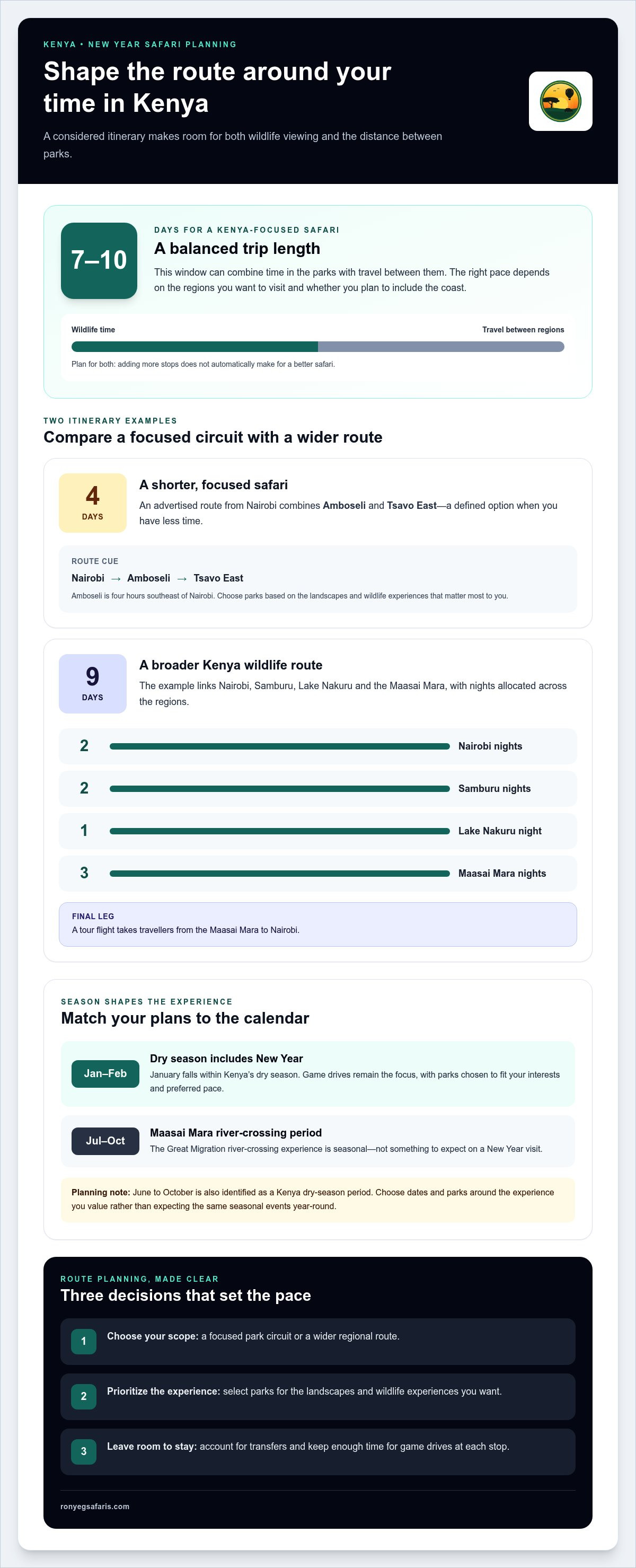
For a Kenya-only wildlife safari, allow seven to ten days to combine parks with time for travel. Grand European Travel recommends this length for Kenya’s wildlife, national parks and coastal attractions. The right pace depends on how many regions you want to visit and whether you plan to include the coast. For a multi-country itinerary, account for transfers and border crossings by choosing fewer stops in Kenya instead of trying to cover every park.
A shorter route can still offer a focused wildlife safari. An advertised four-day itinerary from Nairobi combines Amboseli and Tsavo East, giving travellers with less time a defined option. Amboseli is four hours southeast of Nairobi. Use the route as a model for prioritising parks: decide whether elephants, open plains or varied habitats matter most, then plan around those interests.
For a broader Kenya wildlife experience, a nine-day itinerary can link Nairobi, Samburu, Lake Nakuru and the Maasai Mara. This example allows two nights in Nairobi, two in Samburu, one at Lake Nakuru and three in the Maasai Mara. The final leg from the Mara to Nairobi is by tour flight. This distribution shows how to combine several regions without reducing every stop to a day visit.
For a 2027 safari, start by choosing between a focused park circuit and a wider regional route. Match the trip length to the places you want to see, then account for the time spent moving between them. January falls within Kenya’s dry season, alongside June to October. A festive itinerary can therefore be planned around park priorities, with a coast extension added when beach time matters as much as wildlife.
For US travellers, the research guidance says a visa is required for Kenya and can be obtained online or upon arrival at major entry points. It also advises having a passport valid for six months after the planned return to the US. The guidance recommends yellow fever, hepatitis A and typhoid vaccinations; seek current health advice from a doctor or travel health clinic.
The nine-day route includes overnight stays in Nairobi, Samburu, Lake Nakuru and the Maasai Mara. Choose a lodge or camp to fit the sequence of parks and the nights planned in each location.
New Year celebrations vary by lodge and camp. When choosing a festive stay, ask about the planned evening programme, while keeping the safari schedule central to your decision.
To combine a safari with a beach holiday in January 2027, place the coast after the parks and reserve time for both experiences. Diani is one Kenyan beach destination that can follow a wildlife-focused route.
Travel between Nairobi, the parks and the coast can be arranged by road or air. In the nine-day example, a tour flight takes travellers from the Maasai Mara to Nairobi for the final leg.
For safety, follow your guide’s instructions and park rules, and review current US travel advisories before departure. Conditions and guidance can vary by destination and travel date.
Wildlife viewing in Kenya's national parks
Kenya’s parks offer different landscapes and wildlife experiences, so choose destinations based on your priorities. For the Maasai Mara, season matters, especially if river crossings are central to your plans.
Wildlife-Focused Trips
A wildlife-focused trip puts game drives at the centre of the itinerary. Before choosing parks, decide whether you prefer to focus on one reserve or travel across several regions. The Maasai Mara is associated with Great Migration river-crossing experiences, while Amboseli, Samburu and Lake Nakuru bring different settings to a Kenya route. Compare travel time, nights in each area and the wildlife experiences you most want.
In the Maasai Mara, the Great Migration river-crossing period is July to October. This is a seasonal experience, not one to expect on a New Year visit. A Kenya safari around January can still focus on game drives and wildlife viewing, but follows a different seasonal rhythm. Plan around the time of year, then choose parks that match the experience you value most.
For a route across Kenya, compare the Maasai Mara with Amboseli, Samburu or Tsavo. Staying in one national park or reserve allows more time in one landscape; a multi-park circuit adds variety but also travel between regions. Before adding another stop, decide how much time you want to spend on game drives versus road transfers. This keeps the wildlife focus clear.
Holiday-Season Viewing Conditions
Kenya’s dry seasons fall in June to October and January to February, periods identified as ideal for wildlife safaris and outdoor activities. During the holiday season, game drives are the main way to view wildlife. Follow your guide’s instructions and park rules, keep noise low, and avoid disturbing animals or leaving designated areas.
January’s dry-season timing differs from the Maasai Mara’s July-to-October river-crossing period. Choose January for a New Year wildlife safari, and treat individual animal sightings as part of the changing conditions of the wild, not the sole measure of the trip. Your choice of parks and the time spent in each area shape the experience.
For Maasai Mara wildlife experiences, decide whether you want a focused stay or a wider route connecting several parks. A longer stay allows more opportunities for game drives in the same landscape, while a multi-park itinerary introduces different regions. Make sure the route leaves enough time at each stop instead of turning every park into a brief transfer point.
A thoughtful wildlife itinerary starts with the season, then matches parks and nights to the experiences you seek. For New Year travel, January and February are dry-season months. The listed period for Great Migration river crossings in the Maasai Mara is July to October.
2027 Kenya safari departure dates and prices
Listed Kenya safari departures in 2027 span several seasons, with different trip lengths and itineraries. Compare dates against your travel window, then weigh duration and route before choosing.
For a Kenya New Year safari in 2027, plan four to ten months before travel. The January 11-19 Kenya Wildlife Safari departure is listed as sold out, so consider other dates if that itinerary suits your plans.
Safari Dates and Trip Duration
Listed Kenya tours range from four to 27 days, while shorter regional trips include a three-day Amboseli tour and a four-day Samburu and Ol Pejeta safari. A three-day Masai Mara wildebeest-crossing tour is listed for July and August 2027-2028; a fly-in migration safari lasts four days. Match the duration to your route and the time you want in each reserve.
Before settling on dates, identify your priority: a brief park visit, a multi-region circuit or a longer safari. Then compare travel days with nights in the parks. A tour with several destinations covers more ground, while a shorter itinerary can focus on one area. These trade-offs make trip length as important as the departure date.
Tour Departure Years and Dates
January 2027 listings include 55 departures. One Kenya Wildlife Safari runs January 11-19, while further listed departures fall on March 15-23, June 7-15, June 21-29, and October 18-26. October 4-12 is also listed, but that departure is sold out. These examples show why checking the exact start and end dates matters.
Other Kenya Wildlife Safari dates include July 5-13, July 19-27, August 2-10, August 23-31, September 6-14, November 8-16, and November 22-30. The listing describes 67 Kenya tours and safaris with 3,838 departures, across itineraries lasting four to 27 days. Compare the year as well as the month, since some migration tours list departures across 2027 and 2028.
Departure Prices
Safari prices depend on the itinerary, travel dates, accommodation, transport and room arrangements, and are provided after a quote request. For a useful comparison, assess the same elements across options: park route, nights away and whether the itinerary uses road travel or a tour flight.
Availability also differs by departure. The January 11-19 and October 4-12 Kenya Wildlife Safari departures are listed as sold out, while other dates have separate listings. Treat each date as its own option, and compare its duration and route before deciding. An unforgettable journey begins with a departure that fits both your calendar and the places you want to explore.
Nairobi, Samburu, Lake Nakuru, and Maasai Mara
A Kenya Wildlife Safari route linking Nairobi, Samburu, Lake Nakuru and the Maasai Mara brings several regions into one itinerary. The plan balances city stays with time in reserves, then uses a tour flight for the final leg from the Mara to Nairobi.
The route allocates two nights in Nairobi, two in Samburu, one at Lake Nakuru and three in the Maasai Mara. That adds up to eight nights across four locations. Each stop plays a different role, so compare the number of nights alongside transfers and game drives when weighing itineraries.
Nairobi provides the city portion of the route, while Samburu, Lake Nakuru and the Maasai Mara make up its reserve-focused stays. The itinerary moves between distinct regions rather than keeping you in one park. Four stops offer a wider view of Kenya, while Lake Nakuru’s one night is a shorter visit than the two-night Samburu stay or three-night Mara stay.
In the Maasai Mara, three nights make it the longest stay in this itinerary. The schedule gives the Mara more time than Lake Nakuru, which receives one night. Another listed Masai Mara fly-in migration safari includes three nights at Mara Serena Safari Lodge or a similar property. Compare the Mara stay and the rest of the route before choosing between a circuit and a focused migration trip.
The Kenya Wildlife Safari lists eight breakfasts, eight lunches and six dinners. Use these details to understand the tour’s rhythm, then consider how meal arrangements fit the days spent moving between Nairobi, Samburu, Lake Nakuru and the Mara. The final leg back to Nairobi is by tour flight, rather than an entirely road-based route.
For a New Year journey, this itinerary offers a clear way to compare time in parks with time spent travelling. Start with the overnight allocation, then note the tour flight and listed meals. If you want a longer stay in the Maasai Mara, a three-night Mara-based option offers a different emphasis from the four-region circuit.
Both itineraries put the Maasai Mara at the centre of the wildlife experience, but suit different travel preferences. The circuit also includes Nairobi, Samburu and Lake Nakuru; the fly-in option lists three nights at Mara Serena Safari Lodge or a similar property. Compare these details to choose the journey that best fits your interest in Kenya’s varied landscapes.
Dry-season safari timing
Kenya’s dry seasons fall in June to October and January to February, periods identified as ideal for wildlife safaris and outdoor activities. A New Year departure therefore falls within the January-to-February window. Use the season as a starting point, then match your dates to the parks, trip length and experiences you want.
For January travel, start with your preferred departure dates and plan the route around them. Choose the parks first, then allow time to travel between them. An itinerary from Nairobi to Samburu, Lake Nakuru and the Maasai Mara has different logistics from a focused stay in one reserve. Make sure the season suits the experience you want, not just the calendar.
Dry-season timing can help shape a wildlife itinerary, but it doesn’t make every park or activity interchangeable. Decide whether you prefer a longer stay in one landscape or a route through several regions. Then compare the nights allocated to each stop and the time spent travelling. This approach works for a Kenya safari and for a wider adventure that also includes Tanzania.
For a 2027 trip, align the departure month with the experience on your list. January and February fit New Year plans within the listed dry season; June to October offers another dry-season window. The Maasai Mara’s Great Migration river-crossing period is July to October, so travellers seeking that specific experience should plan for those months rather than January.
Use this planning sequence: select the season, identify the key park, set the trip length, then build the route around it. For example, a January itinerary can focus on the Mara or connect several Kenyan parks. If Tanzania is part of the plan, account for the journey between countries when deciding how many Kenyan stops to include.
Season also affects the pace of each day. Keep the itinerary focused on game drives and outdoor activities, with enough time in each location to experience its landscape. Compare your departure dates with your preferred month, then check that the itinerary gives your chosen park sufficient time. A crowded route can dilute the purpose of a wildlife-focused trip.
A thoughtful dry-season safari is shaped by both timing and route. January to February suits a New Year journey, while June to October opens a separate dry-season travel window. Set your priorities before choosing dates, and let the park sequence determine the pace. Plan a Kenya dry-season safari around the season and landscapes that matter most to you.
Ronyeg Kenia Tours and Travels: Tailor-made Kenya safaris
Ronyeg Kenia Tours and Travels designs tailor-made Kenya safaris for travellers choosing between a focused park stay and a wider route. If you’re shaping a New Year journey around specific parks, travel pace, or wildlife priorities, a tailored itinerary can bring those choices together. Festive 2026/27 safaris and safari packages offer further ways to plan a seasonal trip.
For travel professionals arranging Kenya itineraries, the company also provides travel-trade ground partner services. The right next step depends on whether you’re planning your own safari or coordinating travel for clients. Share the route and experiences you have in mind with Ronyeg Kenia Tours and Travels, or visit ronyegsafaris.com.
Shape your New Year journey around what matters
The most meaningful safari plan begins with your own priorities: the landscapes you want to wake to, the pace that feels right, and the experiences you hope to carry home. For a Kenya New Year safari in 2027, bring those choices together before settling on a route. A clear sense of what matters most makes it easier to shape a journey that feels considered rather than hurried.
Ronyeg Kenia Tours and Travels can help turn those priorities into a Kenya itinerary, whether you’re travelling independently or arranging ground services for clients. Contact Ronyeg Kenia Tours and Travels to begin planning. The open country, changing light, and quiet movement of wildlife are waiting to give your New Year journey its own distinct character.
Frequently Asked Questions
What is the weather like in Kenya?
Kenya’s climate varies by region: coastal areas are warm and humid, inland regions are drier, and highlands are cooler, especially at night. One itinerary can therefore involve different conditions as you travel between Nairobi, a safari park and the coast. Pack for the locations on your route rather than a single national climate. For a coast-and-safari journey, prepare for both humidity and cooler evenings inland.
What should I pack for my trip to Kenya?
Pack for conditions across your route, including warm, humid weather at the coast and cooler highland nights. Lightweight clothing suits warm daytime conditions, while an extra layer helps after sunset in cooler areas. For game drives, choose practical clothes that remain comfortable when sitting for extended periods. Keep essentials accessible during transfers between Nairobi, parks and coastal stays, so you have suitable clothing as conditions change.
When is the best time to tour Kenya?
The best timing depends on your priorities. Kenya’s dry-season travel periods are January to February and June to October, making either window a useful starting point for outdoor plans. If Maasai Mara river crossings are your main goal, the listed period is July to October. For a New Year trip, prioritise parks and experiences that suit the season instead of building the itinerary around a different seasonal event.
What are the best Kenya safari destinations for New Year 2027?
For a Kenya New Year safari in 2027, choose destinations by landscape and route. Amboseli and Tsavo suit a southern circuit, while Samburu and the Maasai Mara offer other wildlife settings. Lake Nakuru can form part of a multi-region itinerary, and Diani adds a coastal stay. Choose a central priority first, such as varied parks or a safari followed by beach time, then shape the route around it.
How much do Kenya safari packages cost during New Year 2027?
Safari package prices depend on the itinerary and are provided after a quote request. The route, number of nights, accommodation choices and road or air travel all influence the quoted cost. For a useful comparison, decide which parks matter most and whether you want a coast extension, then compare itineraries with similar arrangements. This keeps the decision focused on what the package includes, not price alone.
What is the weather like in Kenya in late December and early January?
Late December and early January fall around Kenya’s January-to-February dry-season period, but conditions still vary by region. Coastal areas are warm and humid, inland areas are drier, and highlands can feel cooler at night. If your itinerary moves between Nairobi, parks and the coast, expect different conditions during one trip. Pack adaptable layers and plan clothing around each destination, not just the season.
What are the main safety risks and travel advisories for a Kenya safari?
Follow your guide’s instructions and park rules, and review current US travel advisories before departure. Conditions and guidance can vary by destination and travel date.


