

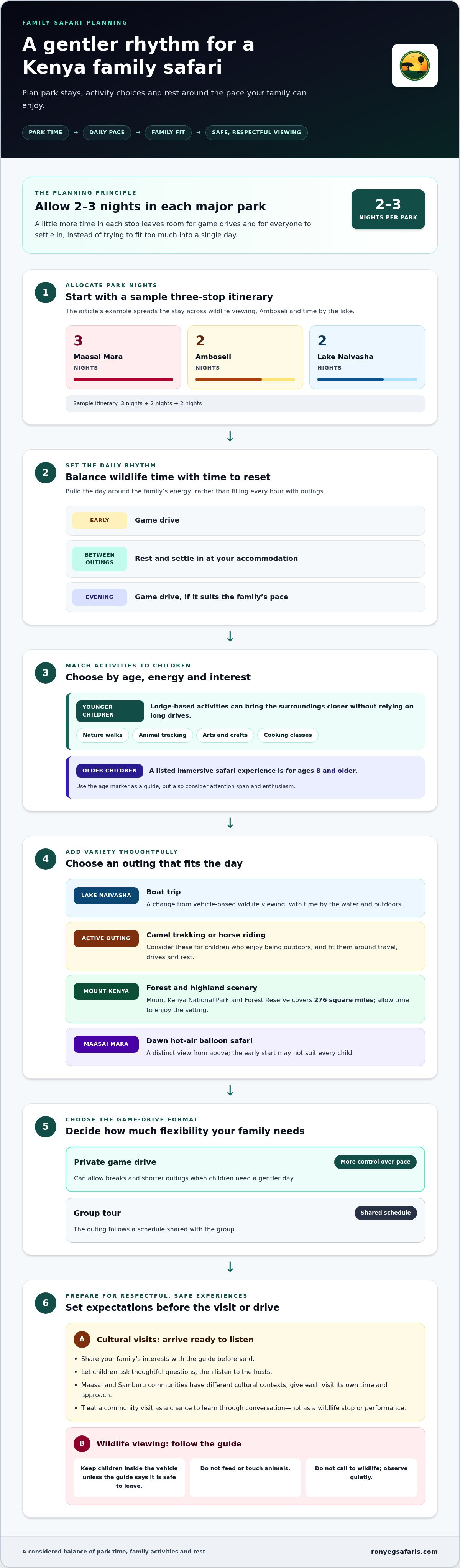
A Kenya safari for families is easier to pace when you allow 2-3 nights in each major park, rather than trying to see too much in a single day. A family itinerary can include 3 nights in the Maasai Mara, 2 in Amboseli and 2 at Lake Naivasha, leaving room for game drives and time to settle in.
It’s natural to want close wildlife encounters while keeping the days comfortable for children. The right rhythm matters: early and evening game drives, time to rest at your accommodation, and activities suited to your family can make the journey feel less rushed.
This guide explains how to plan time across Kenya’s parks, choose wildlife experiences and family activities, and select accommodation that fits your needs. You’ll also find practical itinerary ideas for balancing safari days with quieter moments, so the journey feels manageable for everyone.
Key Takeaways
- Match activities to children’s ages and interests, from lodge-based nature walks and crafts to experiences designed for older children.
- Build cultural experiences around respectful interaction, with options such as camel trekking, horse riding and visits with Maasai or Samburu communities.
- Choose a private game drive when your family needs more flexibility for breaks, shorter outings or a gentler pace.
- Compare exclusive-use villas, tented camps and lodges by the kind of family stay and daily rhythm you want.
- Shape the itinerary around the parks, wildlife experiences and rest time that matter most to your family.
What are the best family-friendly activities and attractions in Kenya?
Kenya offers families different ways to experience its landscapes, from wildlife viewing to time on Lake Naivasha. Choose activities based on your children’s ages, energy levels and interest in active outings.
Age-Based Child-Friendly Activities
For younger children, look for lodge activities such as nature walks, animal tracking, arts and crafts, or cooking classes. These bring the surroundings closer without making every day depend on long game drives.
Older children may enjoy a more immersive safari adventure. One family safari experience is listed for ages 8 and older, giving families a useful age marker when comparing activities. Match the outing to a child’s attention span and enthusiasm, not age alone.
Active Family Adventures
For families who want to get moving between wildlife sightings, options can include camel trekking and horse riding. These outings offer a different view of the terrain and can add a shared adventure to a Kenya itinerary.
Consider how an active excursion fits alongside game drives and rest time. A horse ride or camel trek may suit children who enjoy being outdoors, while a gentler lodge activity may be a better fit on a day that already includes travel.
Lake Naivasha adds a change of pace. A boat trip lets families experience the lake from the water, with time for nearby activities and the outdoors. Include Lake Naivasha when you want variety beyond vehicle-based wildlife viewing. Its place in the itinerary can also offer a natural pause between busier safari days.
Mount Kenya National Park and Forest Reserve covers 276 square miles. Families can make this region part of an outdoors-focused itinerary, choosing activities that suit their children’s energy and interests. The mountain setting offers a contrast to open savannah and game drives, with forest and highland scenery shaping the experience. Allow time to enjoy the setting rather than treating the park only as a transfer point.
A hot-air balloon safari over the Maasai Mara launches at dawn, taking families above the landscape as the day begins. It’s a distinct experience from a vehicle-based game drive, but the early start may not suit every child. Consider whether your children enjoy early mornings and quiet observation before adding it to the plan.
Children’s programs can give parents and young travellers different ways to enjoy a lodge stay. Nature walks, animal tracking, arts and crafts, and cooking classes offer practical activities rooted in the place. Ask which options best match your children’s ages and interests as you shape the family itinerary.
Maasai cultural experiences
A cultural visit can help children understand Kenya beyond wildlife viewing. Treat it as an opportunity to listen and learn, rather than another activity to hurry through between game drives and wildebeest sightings.
Before the visit, discuss what your family hopes to learn and share those interests with the guide. Children might be curious about daily life, local traditions or how people relate to the surrounding land. Let their questions shape the conversation, while allowing hosts to guide what they wish to discuss. This preparation helps families arrive ready to listen, not expecting a performance.
Maasai and Samburu communities offer different cultural contexts, so avoid treating one visit as representative of both. If your itinerary includes encounters with both communities, give each experience its own time and approach. Ask your guide to introduce the community and explain the visit’s format before you arrive. Families can help children notice differences without comparing people or expecting identical customs.
In the Maasai Mara, wildlife and cultural experiences can be part of the same broader journey, but they serve different purposes. A game drive focuses on animal movement and observation; a community visit centres on meeting people and learning through conversation. Keep those expectations separate when planning the day. Children can prepare a thoughtful question, then listen to the answers rather than treating the visit as a wildlife stop.
Make practical choices before adding a cultural visit: consider your children’s interest in conversation, the journey between activities, and how much time the family wants for each experience. A well-paced visit leaves room for listening and reflection. Keep the agreed per-person cost in mind as you plan the family budget, and make the visit’s purpose clear to children beforehand. For a journey that brings community experiences together with wildlife days, explore family safari itinerary planning.
The 8-Day Classic Kenya: Family 4x4 Safari Experience accommodates all ages, making it an option for families with children at different stages. Families travelling during July to October may also encounter the Great Migration, described as involving around two million wildebeest crossing Kenya’s Maasai Mara reserve.
Family safari experiences and wildlife viewing
Family wildlife viewing combines game drives, time to rest and choices shaped by children’s ages. Private guiding can make the day more flexible.
Safari Experiences for Children
Wildlife viewing is more engaging for children when there’s time to watch rather than rush between sightings. On a private game drive, families can take breaks or choose shorter outings, which may suit younger children. A group tour follows a shared schedule, while a private safari gives you more control over timing and pace.
Wildlife Safety Rules
Follow the guide’s instructions during every wildlife encounter. Keep children inside the vehicle unless the guide says it’s safe to leave, and don’t feed, touch or call to animals. Quiet observation helps your family respect wildlife and notice natural behaviour. Explain these rules before the first drive, then reinforce them whenever the vehicle stops.
Safari Timing and Travel Routes
Family wildlife viewing is generally more reliable in Kenya’s dry seasons, June to October and January to February. The Great Migration crosses the Maasai Mara from July to October, though sightings depend on animal movement. Plan transfers from Nairobi around your chosen parks and the order of visits, allowing the route to shape each day’s pace.
If you’re travelling between Nairobi and safari parks, plan each transfer as part of the itinerary, not as spare time between activities. The route and park sequence affect how the journey fits around game drives and children’s rest. Nairobi National Park is half an hour from the city centre, making it a practical wildlife experience near the capital.
The Great Migration brings over two million wildebeest and zebra from the southern Serengeti to the Maasai Mara between August and November. It can become a memorable part of a family journey, but wildlife viewing also depends on the wider season and your family’s preferred pace. Choose dates around the experience that matters most.
Families planning a safari should consult a doctor about recommended vaccinations and malaria prevention. For travel insurance, review the policy’s medical and emergency provisions for every family member. Pack children’s familiar essentials, such as sun protection, a hat, comfortable layers and any personal medicines. Keep key items easy to reach during transfers and game drives.
A travel expert can help arrange Nairobi, the parks and rest days around your children’s needs. Share their ages, interests and preferred pace, then use those details to shape the route and wildlife experiences.
Family-friendly safari hotels and lodges
Accommodation shapes how your family rests between wildlife outings. Kenya’s family-friendly options include exclusive-use villas, tented camps and luxury lodges. Compare them by your family’s preferred style of stay, the children’s needs and how each destination fits the route. A convenient base for the day’s activities can help keep the itinerary practical.
An exclusive-use villa may suit families who value shared space and privacy, while a tented camp brings the sounds and textures of the landscape closer. Luxury lodges offer another style of stay. These are different accommodation types, so decide whether your family prioritises a private setting, a camp atmosphere or lodge facilities.
Location matters as much as accommodation style. The Maasai Mara, Amboseli and Laikipia are family-suitable safari regions, each offering a different setting for wildlife viewing. Consider which destinations best match your family’s interests, then choose accommodation that supports the route. For example, families drawn to elephants may make Amboseli a priority.
Plan nights around the effort of reaching each destination and the time you want for wildlife viewing. A useful itinerary framework is 2-3 nights in each major park. One suggested sequence is 3 nights in the Maasai Mara, 2 in Amboseli and 2 at Lake Naivasha. Treat this as a starting point, then adjust the route to your family’s interests and travel pace.
Meals are another practical part of choosing family accommodation. Many Kenyan safari lodges and camps provide Western-style meals and can accommodate specific dietary requirements. Share your family’s food needs while planning, especially if children rely on familiar meals. This helps you compare stays by how they fit everyday routines, not only their setting near wildlife.
Before choosing a camp or lodge, consider the full rhythm of the day: travel to the destination, time outdoors, meals and rest. Accommodation that works well between outings may matter more than adding another location. For example, families who want to visit both the Maasai Mara and Amboseli can weigh the travel sequence alongside their preferred accommodation style.
Build the final plan by matching each stay to the park experience. Choose a villa, tented camp or lodge, then consider how the destination order supports your family’s priorities. A well-paced itinerary gives children time to settle into each place, notice the changing landscape and enjoy wildlife experiences without turning every day into a transfer.
Kenya family safari itinerary options
A family itinerary works best when its length, park choices and daily pace suit the children travelling. Start with the wildlife experiences that matter most, then arrange the route around them rather than collecting destinations.
For a shorter journey, an eight-day family safari designed for children aged two to five offers one useful planning reference. A 10-day family safari option is suited to children aged eight and older. These examples show why age and trip length belong together: younger children may need a gentler rhythm, while older ones may welcome more varied outings.
Choose parks based on the wildlife and scenery your family hopes to experience. The Maasai Mara is known for migration viewing, while Amboseli may suit families drawn to elephants. Laikipia offers another family-suitable region. Choosing a clear priority helps keep the route purposeful and gives children time to notice more than the next transfer.
For a safari focused on classic wildlife viewing, centre the plan on one or two regions rather than adding a park for every available day. A Maasai Mara and Amboseli route, for example, combines open savannah with elephant country. Families with a longer stay can consider adding Laikipia or Lake Naivasha, provided the extra destination supports the experience they want.
Use this planning sequence to shape the itinerary:
- Set the pace: decide how much time your family wants for game drives, rest and activities.
- Choose priorities: select wildlife or landscapes, such as elephants in Amboseli or migration in the Maasai Mara.
- Order the destinations: arrange the parks to make transfers part of the route, not interruptions between experiences.
- Allow room to observe: leave time for spotting giraffes, watching animal behaviour and taking breaks.
The season can guide the order, too. The Maasai Mara’s peak season is July to September, when the annual wildebeest migration takes place. If migration viewing is your priority, shape your dates around this period. For other wildlife interests, consider the dry seasons, when family wildlife viewing is most reliable.
Keep the itinerary adaptable in its daily rhythm, even when destinations and travel dates are set. A private guide and vehicle can make shorter game drives and breaks easier to arrange for young children. For a family route built around your chosen parks, interests and pace, plan a tailor-made Kenya safari.
Options include Kenya's Amboseli, Laikipia & Mara itinerary at 10 days, Kenya’s Wilderness, Farmlands & Wildlife itinerary at 11 days, and Kenya's Best-Value Mara & Diani Beach itinerary at 9 days.
Ronyeg Kenia Tours and Travels: Tailor-made Kenya safaris
Ronyeg Kenia Tours and Travels can shape a tailor-made Kenya safari around your family’s priorities, from park choices and wildlife interests to the pace of each day. Turn to the team when you want to bring itinerary decisions together into one coherent journey, rather than choosing destinations and activities separately.
Share the children’s ages, preferred experiences and the time you have for travel. These details help guide a route that balances game drives, accommodation and quieter moments. Families planning around the festive season can also consider Festive 2026/27 safaris, while travel businesses can enquire about ground partner services.
For a family journey shaped around your priorities, contact Ronyeg Kenia Tours and Travels.
Begin shaping your family’s journey
The most meaningful Kenya safari for families begins with a shared idea of what the journey should feel like. Before choosing dates or settling on a route, decide what your family wants to carry home: the quiet of watching wildlife, the excitement of a new landscape, or time spent learning from local communities. That starting point can guide practical choices without making the trip feel like a checklist.
Bring those priorities together with your children’s ages, interests and preferred pace. Ronyeg Kenia Tours and Travels offers tailor-made Kenya safaris, Festive 2026/27 safaris and travel-trade ground partner services. Families can begin a planning conversation with their priorities in view, while travel professionals can explore ground partner support for Kenya arrangements.
Contact Ronyeg Kenia Tours and Travels to begin shaping a safari around the experiences your family values. Kenya’s open country and changing light offer a generous setting for a journey you can make your own.
Frequently Asked Questions
How long should families plan to stay in each national park?
Allow 2-3 nights in each major park as a useful planning guide. For example, a route can include 3 nights in the Maasai Mara, 2 in Amboseli and 2 at Lake Naivasha. Use that pattern to decide whether the journey has enough time for wildlife viewing and rest, then adjust the park sequence to suit your family’s interests and transfer plans.
What types of accommodation are available for families in Kenya?
A Kenya safari for families can include stays in exclusive-use villas, tented camps or luxury lodges. Think about how your family uses shared space: a villa offers an exclusive setting, while a tented camp brings you closer to the outdoors. Lodge stays provide another kind of base. If children need familiar routines, consider how meals and downtime will fit between excursions.
What are the best family-friendly safari destinations in Kenya?
The Maasai Mara, Amboseli and Laikipia are family-suitable safari regions. For a Kenya safari for families, choose based on what matters most: migration viewing in the Mara, elephants in Amboseli, or a different setting in Laikipia. Let those priorities shape the route, rather than adding destinations simply to visit more places.
Which Kenya safari parks are best for seeing the Big Five with children?
Consider the Maasai Mara, Amboseli or Laikipia for a family safari, then discuss your Big Five priorities when arranging the route. Each destination brings a different landscape and wildlife focus, so the right choice depends on the overall experience you want. Keep children engaged by allowing time to observe animals, rather than making the day only about completing a checklist.
What are the age limits for children on Kenya safari game drives and activities?
Age guidance depends on the particular activity. One family safari experience is designed for children aged 2-5, while a separate adventure is listed for ages 8 and older. These examples aren’t universal age limits for every game drive or lodge activity. Use each activity’s stated age range when planning, and match the day’s pace to your child’s comfort and interests.
Which family-friendly safari lodges and camps in Kenya offer family rooms or child programs?
Some Kenyan lodges and camps offer children’s programs, including nature walks, animal tracking, arts and crafts, and cooking classes. Family accommodation options include exclusive-use villas, tented camps and lodges. When planning a stay with children, compare the accommodation style with your family’s preferred daily routine, and consider whether a child-focused activity would add variety between wildlife outings.


