

The drive from Nairobi to Amboseli takes approximately 3 to 4.5 hours, depending on the camp booked. An Amboseli safari package also needs to account for where you’ll stay and what is included in the journey. The road carries you from the city toward open plains beneath Kilimanjaro.
When comparing an Amboseli safari package, look beyond the headline itinerary. Accommodation, transport, park entry and game drives all shape the experience and what the total cost covers. A well-planned stay balances time in the landscape with practical details.
This guide explains what safari packages commonly include, what affects accommodation and trip costs, and how different stay lengths shape the experience. It also covers when to travel for the best chance of clear Kilimanjaro views and what to consider when comparing a road journey with other ways of reaching the park. Use these details to choose a pace and setting that suit you.
Key Takeaways
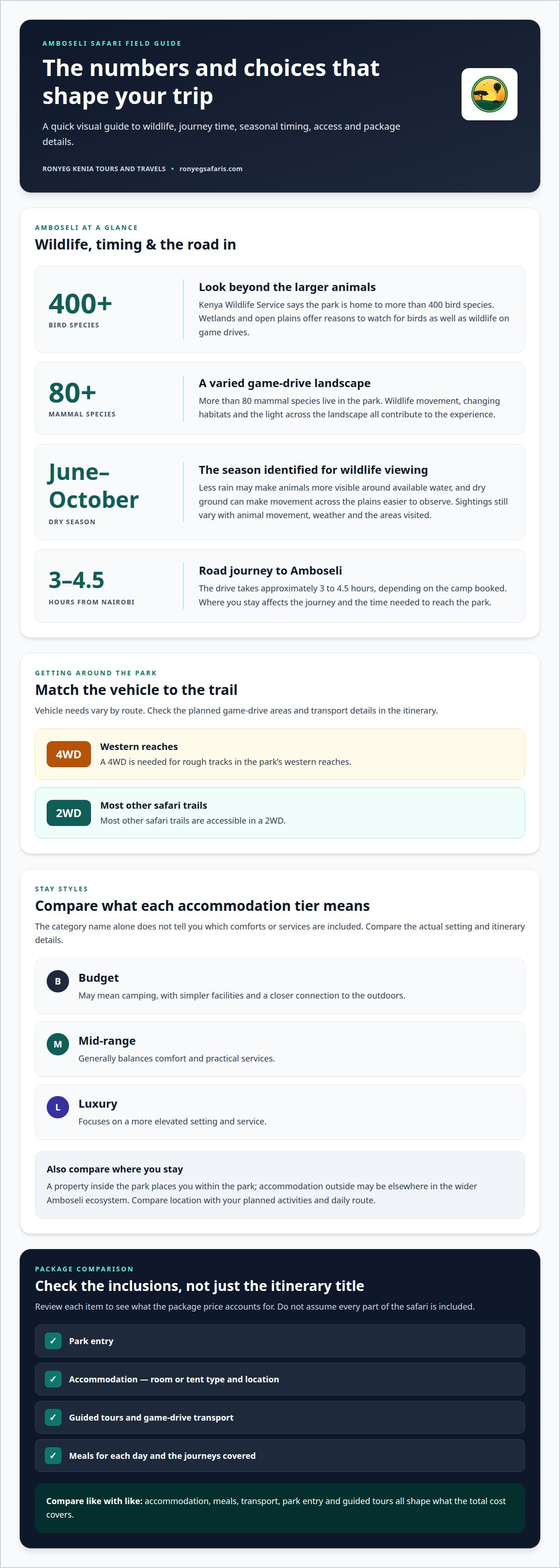
- Amboseli’s wildlife extends beyond its famous elephants: Kenya Wildlife Service says the park is home to more than 400 bird species.
- Match your accommodation style to the kind of stay you want, then compare what each package includes before weighing options.
- For rough tracks in the park’s western reaches, a 4WD is needed; most other safari trails are accessible in a 2WD.
- Look closely at whether park entry, accommodation and guided tours are covered, so you can understand what the package price accounts for.
- Plan your timing with Kilimanjaro views in mind, while leaving room for the mountain’s visibility to shape the experience.
What are the best reasons to visit Amboseli?
Amboseli brings wildlife, open country and the presence of Maasai culture into one Kenyan journey. Kenya Wildlife Service says Amboseli National Park is home to more than 400 bird species. That richness gives birdwatchers reason to look beyond the larger animals, especially around wetlands and open plains. More than 80 mammal species also live in the park, adding variety to a game drive. The experience is not defined by one sighting alone. It unfolds through changing habitats, animal movement and the light across the landscape.
The dry season, from June to October, is identified as the best time to visit for wildlife viewing. With less rain, animals may gather more visibly around available water, and dry ground can make movement across the plains easier to observe. This season suits travellers focused on game drives and wildlife watching. Sightings still vary with animal movement, weather and the areas visited on each drive.
Amboseli’s appeal also lies in its distinctive setting. The broad horizon and open grassland offer a different rhythm from a busy city or tightly scheduled itinerary. A morning drive can focus on wildlife, while a slower stretch of the day leaves room to notice birds, tracks and changing clouds. When Kilimanjaro is visible, its distant outline adds another layer to the view. Taking time to observe can be as rewarding as moving between sightings.
A Maasai village visit can add cultural context to a safari. Treat it as an opportunity to listen and learn, not simply as a backdrop for photographs. Arrange the visit respectfully, follow your guide’s direction and ask permission before photographing people. Make space for conversation and local perspectives, while remembering that Maasai communities have their own priorities and daily routines beyond a visitor’s itinerary.
Before planning each day, decide what matters most. Choose June to October if travelling in the dry season is your priority, and allow time for both game drives and quieter observation if you’re interested in birds. If you’d like a Maasai village visit, mention it during planning so it can be considered alongside park activities. Keep the pace deliberate: Amboseli rewards attention to wildlife, landscape and the wider region’s cultural context.
Budget, mid-range, and luxury accommodation
In the Amboseli ecosystem, accommodation shapes your daily rhythm as much as your room. Compare the setting, meals, transport and time needed to reach Amboseli National Park before choosing where to stay.
Accommodation Price Tiers
Budget accommodation may mean camping, with simpler facilities and a closer connection to the outdoors. Mid-range stays generally balance comfort and practical services, while luxury options focus on a more elevated setting and service. Compare the actual inclusions, not just the category name.
For each option, check the room or tent, meals and transport arrangements. A tented stay may feel different from a lodge, but the label alone doesn’t explain which comforts or services are included. Match the accommodation to how much time you expect to spend there between drives.
Where to Stay
Staying inside Amboseli National Park places you within the park, while accommodation outside it may be elsewhere in the wider Amboseli ecosystem. Compare each property’s location with your planned activities and daily route. The ecosystem extends beyond the park boundary, so a stay outside the gates can still be part of an Amboseli itinerary.
Check how the accommodation’s location affects your schedule. Its position shapes the journey between your room and planned activities, so consider whether you want to spend more time inside the park or explore a broader area.
Give meals and transport as much attention as the room category. Read the itinerary’s meal arrangements for each day, then identify which journeys are covered and where they begin. A package may list accommodation and meals separately from game-drive transport. Compare each item on its own instead of assuming the room rate includes every part of the safari.
For a clear comparison, make a checklist of accommodation location, room or tent type, meals and transport. Compare the same details across each itinerary. This can show whether a budget stay works as a simple base for exploring or whether a mid-range or luxury setting better suits the time you want to spend at camp. The right balance depends on your priorities, not the category name alone.
If you’re shaping an itinerary around the park, use safari planning details to think through how accommodation, meals, and transport fit together. A careful comparison of these parts gives the stay a clearer shape before you move to the next decision.
Mount Kilimanjaro views
On an Amboseli safari, elephants and other wildlife move across open country beneath Mount Kilimanjaro’s distant outline. The mountain’s visibility changes with cloud and weather, so views can appear and fade during your visit.
Amboseli’s broad plains give Mount Kilimanjaro a striking place in the landscape. With few tall features interrupting the horizon, the mountain can form a dramatic backdrop to wildlife sightings. Elephant herds crossing the foreground create a contrast with its still, distant slopes. The view depends on the conditions at that moment, so it isn’t a constant feature of every game drive.
Cloud may cover the summit or soften its outline, while clearer spells reveal more of the mountain. Changing light gives the same stretch of Amboseli a different character throughout the day. Look beyond the nearest animal sighting: a pause at an open viewpoint may bring the mountain into view, while another stop may offer a closer look at wildlife.
For the best seasonal chance of seeing Kilimanjaro, plan your visit during the dry season from June to October, identified as Amboseli’s best visiting period. This is a guide, not a promise that the summit will be visible on a particular day. Cloud remains the deciding factor. A flexible game-drive schedule gives you more opportunities to notice when the horizon opens.
Amboseli lodges and camps vary in setting, so consider where you’ll spend time between drives. An open view from camp can make the mountain part of your quieter moments, while a game drive offers changing angles across the plains. Look at how the accommodation’s location fits your daily route and preferred pace. Its setting influences how the surrounding landscape becomes part of your stay.
Bring binoculars for distant wildlife and keep a camera ready in case the mountain appears. Frame Mount Kilimanjaro with the open plain or wait for elephants to cross the foreground. A guide can help identify wildlife and choose a suitable place to pause. These simple choices help you take in the whole scene, not just the summit or a single animal.
On an Amboseli safari, leave time to observe both the mountain and the wildlife around it. A memorable view might be a clear summit, elephants on the plain or both in one quiet moment.
When is the best time to go on an Amboseli safari?
Pack layered clothing, closed shoes, a hat, sunscreen and binoculars for changing conditions and wildlife viewing. The Centers for Disease Control and Prevention notes that multiple vaccinations might be required for healthy safari travel. International travellers generally don’t need compulsory vaccinations for Kenya unless arriving from, or transiting through, a Yellow Fever risk area.
June to October is Amboseli National Park’s dry season and its best visiting period. Drier conditions can make wildlife easier to spot across open ground, while a clear spell may reveal Kilimanjaro. It’s a useful season for travellers focused on game drives, but weather and visibility still shape each day. Tented camps and lodges can provide a base for early starts and time on the plains.
From Nairobi, the drive to Amboseli takes approximately 3 to 4.5 hours, depending on the camp booked. The park lies about 240 km (150 miles) southeast of the city. Allow for the road journey when planning arrival and departure days, especially if you want time for wildlife viewing after reaching camp. The route and final accommodation location both affect the day’s rhythm.
Road conditions matter most on the final approaches and within the park. Most Amboseli safari trails are accessible in a 2WD vehicle, though tracks in the western sector may require more capability. A 4WD vehicle is needed for the rough tracks from Namanga, at the Kenya-Tanzania border, through the park’s western reaches. Match the vehicle to the route, not simply the destination name.
Road safari package costs vary with trip duration, accommodation category, transport and included activities. The price of an Amboseli safari package depends on the itinerary and is provided after a quote request. Compare inclusions side by side: park entry, meals, accommodation and game drives affect what the total covers. A budget camping itinerary and a luxury lodge stay suit different priorities.
Before choosing a road itinerary, check where you’ll stay each night and how the route connects Nairobi, the park and your camp. A shorter stay leaves less flexibility around travel time, while a longer itinerary may allow additional drives. Consider which species and landscapes matter most, then compare the schedule with your preferred pace.
Keep essentials accessible during the drive rather than buried in your luggage. A light layer, sun protection, water and binoculars are practical companions for changing conditions between Nairobi and Amboseli. Review accommodation and transport details together: the camp’s location and the route shape how each day begins and ends.
Safari costs and package inclusions
The total cost of an Amboseli safari depends on the itinerary, accommodation, transport and activities. Compare the full arrangement rather than judging by the headline price alone. Camping and a luxury lodge itinerary offer different levels of comfort and service, while trip length affects the number of planned nights and drives.
The price of an Amboseli safari package depends on the itinerary and is provided after a quote request. Key cost factors include accommodation category, number of nights, travel arrangements, park entry, meals and guided activities. Review these details to understand what the quote covers and which parts of the journey need separate budgeting.
Start by reviewing the itinerary’s inclusions. Look for clear details about accommodation, meals, transport, park entry and game drives. A package may group some costs together and list others separately. Don’t assume that “full package” explains every component; use the itemized details to understand what’s planned for each day.
- Accommodation: Note the property or camp type and how many nights the itinerary includes.
- Meals: Identify which meals are covered on travel days and during your stay.
- Transport: Check how the itinerary describes travel between Nairobi, Amboseli, and accommodation.
- Park entry and activities: Look for these as explicit inclusions, rather than assuming they are bundled.
- Guides and game drives: Compare the planned viewing time and how drives fit into each day.
These details affect the experience as well as the budget. A schedule with several game drives, for example, sets aside more planned time for wildlife viewing than an itinerary focused mainly on reaching camp. Elephants may be a central draw, but the day’s quality also depends on its pace, route and time outdoors. Read the daily plan alongside the inclusions.
To compare two proposals, place their details side by side. Match the number of nights, accommodation level, meals, transport and activities before comparing total costs. If one itinerary specifies park entry and guided drives while another leaves those details unclear, the totals may cover different experiences. A clear breakdown makes the comparison more useful.
Planning an itinerary around your priorities can help bring those pieces together. Request a tailored safari quote with your preferred accommodation style, trip length, and activities, so the proposed arrangement can address the parts that matter most to you.
Ronyeg Kenia Tours and Travels: Tailor-made Kenya safaris
Ronyeg Kenia Tours and Travels offers tailor-made Kenya safaris and safari packages for travellers shaping an Amboseli journey around their preferred pace, accommodation style, and wildlife interests. Turn to the team when you want those choices brought into one itinerary, rather than selecting each element separately. Festive 2026/27 safaris are also available for travel planned around that season, while travel-trade ground partner services support industry partners arranging Kenya trips.
Share the type of stay and experience you have in mind, such as time for game drives, a preferred accommodation category or a wider Kenya itinerary. These priorities can help shape your safari plans.
To discuss an itinerary for Amboseli, contact Ronyeg Kenia Tours and Travels.
Give your Amboseli plans a clear starting point
When planning an Amboseli safari package, begin with the experience you want to take home. Decide whether your priority is an unhurried stay, time focused on wildlife or a wider journey through Kenya. A clear first choice turns a range of possibilities into an itinerary with its own pace and purpose.
Next, note the practical details that matter to your party: preferred travel dates, accommodation style and how you want each day to unfold. Keep the list focused. A few clear priorities make it easier to discuss trade-offs and shape a considered plan without crowding the itinerary with activities.
Ronyeg Kenia Tours and Travels can help shape those priorities into a Kenya itinerary. Discuss your Amboseli plans and take the next step toward a journey grounded in the landscapes and experiences that matter to you.
Frequently Asked Questions
How long is the drive to Amboseli?
The drive from Nairobi to Amboseli takes approximately 3 to 4.5 hours, depending on the camp booked. The journey is around 240 km (150 miles) southeast from the city. Plan the arrival day around reaching your accommodation, rather than expecting a full day of activities. The camp’s location influences the route and how much time remains for settling in after the drive.
What lodges or camps would you recommend?
Choose a lodge or camp based on its setting and the rhythm you want for your stay. Consider whether you prefer a permanent lodge or tented camp, and whether you want to stay inside the park or elsewhere in the ecosystem. If you value time at camp, its atmosphere may matter most; if you’re focused on drives, weigh its location more heavily.
Where is Amboseli National Park?
Amboseli National Park is in southeastern Kenya, about 240 km (150 miles) southeast of Nairobi, at coordinates -2.65°, 37.24°. Its position makes it accessible by road from the capital. Travellers from the USA can plan the Kenya portion of their journey around arrival timing and the onward drive. The park’s location also places it within the wider Amboseli ecosystem.
What is included in an Amboseli safari?
Inclusions depend on the itinerary, so review each component rather than relying on its title. Look for accommodation, meals, transport, park entry, game drives and guide services. Check whether meals cover travel days as well as time at camp, and how drives fit into the schedule. A clear breakdown helps you understand what the Amboseli safari package covers each day.
How much does an Amboseli safari cost per person?
The cost depends on the itinerary and is provided after a quote request. Key factors include trip length, accommodation, transport, meals, park entry and planned activities. Party size can also affect how shared arrangements are allocated. Compare options with the same dates and inclusions to judge whether the proposed Amboseli safari package suits your priorities and offers a comparable level of service.
What is a good itinerary for 2, 3, or 4 days?
The right duration depends on how much time you want for activities beyond the journey to camp. A two-day visit suits a brief stay, while three days allow more time in the park. Four days can leave room for extra drives or a slower pace. Compare nights, travel days and planned activities to find an itinerary that fits your available time.
Which itineraries include accommodation, meals, and park fees?
Look for an itinerary that clearly lists accommodation, meals and park entry as inclusions. Check how transport and game drives fit into the schedule, too. Compare meals listed for travel days with those at camp, then match the accommodation nights to the trip length. These details show whether the listed components cover the stay you have in mind.
What is the best time of year to book an Amboseli safari?
June to October is Amboseli’s dry season and is identified as the best time to visit. Choose dates around your priorities, such as wildlife viewing or the chance to see Kilimanjaro, then plan the itinerary accordingly. A defined date range helps you compare accommodation and trip lengths in context, while leaving room to enjoy the landscape at a measured pace.


