

A safari itinerary can cover a lot of ground yet leave little time to experience each place. When travel dates are limited, it’s tempting to fit in every famous reserve. A custom Kenya safari itinerary works better when it gives your priorities room to breathe.
You may want memorable wildlife experiences, comfortable places to stay, and good value without spending too much of the journey in transit. The answer isn’t simply to add destinations. A thoughtful route allows enough time in each place to settle in and enjoy its landscapes and wildlife.
This guide explains how your dates, wildlife interests, accommodation preferences, budget, and travel pace shape an itinerary. You’ll learn how to choose destinations, build a route with a comfortable rhythm, and share the details needed for a tailored proposal. As a Kenyan-owned, on-the-ground destination management company, Ronyeg connects itinerary planning with the arrangements that bring each journey together.
Key Takeaways
- A custom Kenya safari itinerary is shaped by your priorities, not by how many parks you can fit into the route.
- Use your travel dates to guide destination choices, matching the season to the wildlife and landscapes you hope to experience.
- Balance wildlife interests, landscape variety, travel pace, and beach time against the time and logistics each region requires.
- Draft your trip in a clear sequence: set dates, rank priorities, select regions, shape the pace, then review the logistics.
- A concise brief covering your party, dates, interests, budget, and preferred accommodation style helps shape a tailored proposal.
What Makes a Custom Kenya Safari Itinerary Feel Personal?
A personal safari begins with the shape of your days, not a checklist of places. A custom Kenya safari itinerary is designed around your travel dates, interests, budget, and preferred pace, so each choice has a purpose. The word “safari” has a long history and a close association with East Africa; The history and meaning of “safari” offers useful context for the journey its name describes.
Personalization doesn’t mean fitting in the greatest number of parks or activities. Wildlife moves freely through natural settings, and sightings can’t be scheduled. A considered itinerary allows time to enjoy the experience without promising what you’ll see.
A well-paced custom itinerary gives your highest priorities room to unfold while balancing travel, rest, and time in each destination.
Which travel priorities should shape the route?
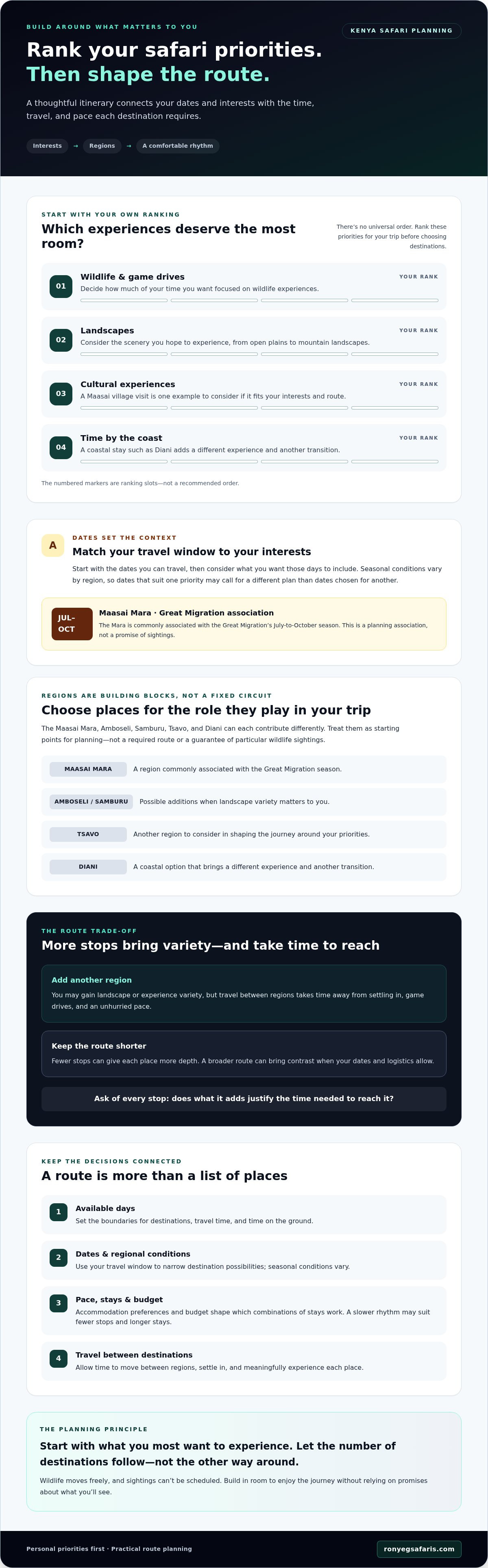
Before choosing destinations, rank the experiences that matter most. A short list turns broad interests into practical route decisions. Consider:
- Wildlife, including time focused on game drives
- Landscapes, from open plains to mountain scenery
- Cultural experiences, such as a Maasai village visit
- Time by the coast as part of a safari and beach journey
Different travellers may rank these differently. A couple might favour quiet time and a slower rhythm; a family may want room to rest between activities. A solo traveller may focus on a particular landscape or wildlife interest, while a small group may need to balance several people’s priorities. Ranking your top interests makes it easier to choose destinations that support the trip you want, rather than adding places simply because they’re well known.
What should a custom itinerary balance?
Available days set the boundaries. Each destination brings travel time as well as time on the ground, so adding another region can reduce time for game drives or make the overall pace feel hurried. Think of the route as a sequence of stays, not just a list of locations: allow for travel between them, time to settle in, and meaningful time to experience each place.
Your accommodation preferences and budget also shape the journey. They influence which combination of stays works for your dates and preferred pace. A clear budget helps guide those decisions from the outset. If you prefer a more restful rhythm, fewer stops and longer stays may suit you better. There’s no single route that works for everyone.
Start with what you most want to experience, then let the number of destinations follow. This gives the wildlife, landscapes, and days between destinations room to shape the rhythm of your trip.
How Dates, Seasons, and Destinations Shape a Kenya Safari Itinerary
Your travel dates help determine which regions make sense, what seasonal conditions to plan around, which wildlife interests guide the route, and what accommodation arrangements fit the journey. Kenya’s landscapes don’t move through the year in exactly the same way, so a date that suits one priority may call for a different plan than a date chosen for another.
In Kenya, itinerary timing is regional: the right dates connect your interests to the conditions and practical arrangements of each place. The Maasai Mara, Amboseli, Samburu, Tsavo, and Diani can each play a different role in a journey. They’re starting points for planning, not a fixed route or a promise of particular sightings.
How should travel dates influence destination choices?
Begin with the dates you can travel, then consider what you most want those days to include. If the Great Migration is a priority, the Maasai Mara is commonly associated with its July-to-October season. Other interests may point toward a different combination of regions or leave space for time on the coast. Seasonal conditions vary, so don’t assume that one month or destination suits every traveller.
Use dates to narrow the possibilities rather than dictate the whole itinerary. Review regional seasonality as you plan, especially before relying on specific claims about wildlife or conditions. The Official Kenya Tourism Board website for travel information can help you explore Kenya’s destinations and travel experiences. A tailored plan can then align those interests with your actual dates.
How much variety can fit without rushing?
Each additional stop brings a trade-off. Travel between regions takes time that could otherwise be spent settling in, enjoying game drives, or taking in a place at an unhurried pace. Adding Amboseli or Samburu, for example, may bring more landscape variety, but it also changes the practical shape of the route. A coastal stay in Diani adds a different kind of experience and another transition to consider.
There’s no fixed number of destinations that makes an itinerary feel complete. Ask whether each stop contributes something you value enough to justify the time spent reaching it. A shorter route can offer depth; a broader one can bring contrast when the dates and logistics allow. The balance depends on your priorities, not on a standard circuit.
For a custom Kenya safari itinerary, treat timing, regional choice, and pace as connected decisions. Ronyeg designs and operates tailor-made Kenya safaris, connecting your interests with practical planning on the ground.
How to Choose Between Safari Priorities Without Overloading Your Route
A route is easier to shape when you decide what matters most before assigning days. Separate must-haves from appealing extras: a wildlife focus may be essential, while a balloon safari or cultural visit could be welcome if the timing and route allow. This isn’t about dismissing good options. It’s about giving your priorities enough time and attention.
Compare regions by the experience you’re seeking, not by a universal ranking. The Maasai Mara, Amboseli, Samburu, and Tsavo offer different settings and may suit different interests. Specific wildlife sightings can’t be promised, so treat interests such as Great Migration crossings as priorities to plan around, not fixed itinerary events.
Fewer, well-chosen stops can make a journey feel fuller by giving each place time to leave its mark. Use the comparison below to identify the balance that best fits your days.
| Priority | What to consider | A planning trade-off |
|---|---|---|
| Wildlife focus | Choose regions around the wildlife experience you hope to pursue. | Adding another wildlife area brings travel and coordination, which can reduce time in each. |
| Landscape variety | Decide how much contrast between settings matters to you. | More regions can mean more transitions between stays. |
| Unhurried pace | Allow time to settle in and enjoy game drives without packing every day. | A slower rhythm may mean leaving some destinations for another visit. |
| Beach time | Consider whether a coastal stay, such as Diani, is part of the experience you want. | Coast time shifts days away from the safari portion and adds a transition. |
How should travellers rank destinations and experiences?
Write down your must-haves first, then list extras separately. Compare destinations by the experience each could support instead of trying to visit every well-known place. A Great Migration crossing, balloon safari, or cultural visit can remain an optional interest until you consider the dates, logistics, and overall pace. This gives the route room to adapt without losing sight of what matters most.
When does a safari-and-coast combination make sense?
A coast stay makes sense when restorative time by the sea is a genuine priority, not simply an expected addition. Diani can bring a different rhythm to a wildlife-focused journey, but it also means balancing coast days against time in safari regions and allowing for the transition. One trip may work well with both; another may feel more satisfying with its days devoted to wildlife.
Travel between regions is part of the decision, too. Road and air options can affect the route’s rhythm and practical arrangements. A custom Kenya safari itinerary should make those choices serve the journey, rather than add stops for their own sake.
A Practical Sequence for Drafting Your Custom Kenya Safari Itinerary
A useful first draft doesn’t need a day-by-day route. It needs a clear order of decisions. Work through these steps to turn your priorities into a practical outline, then refine the details around your dates and arrangements.
- Set your dates. Note your arrival and departure dates, plus any flexibility. Timing helps narrow the regions and seasonal conditions to consider.
- Rank your priorities. Choose what matters most, such as wildlife, particular landscapes, cultural experiences, time on the coast, or a relaxed pace. Separate essentials from optional interests.
- Select regions. Choose places that support your leading priorities. Resist adding a destination just because it is familiar or appears on another traveller’s route.
- Shape the pace. Consider how much time you want in each place and how much travel between stays feels comfortable. Allow time for the experience, not just the transfer.
- Review the logistics. Look at destination changes, accommodation preferences, and how the route fits your dates and budget. Refine the outline wherever the practical details feel compressed.
For example, an outline might include a wildlife-focused stay, one contrasting landscape if it supports the same priorities, and a coastal stay if restorative time by the sea matters to you. This is a planning illustration, not a recommended route for everyone. Your dates, interests, and preferred rhythm should determine the shape.
What information belongs in an itinerary brief?
A concise brief gives itinerary planning a clear starting point. Include who is travelling, your dates, leading interests, budget range, and preferred accommodation style. Note whether you want the journey to focus on wildlife, culture, the coast, or a blend. Include your preferred pace, such as fewer stops with longer stays. A budget range helps guide planning without requiring you to settle every detail upfront.
- Party: who is travelling and any shared priorities
- Dates: travel window and flexibility
- Interests: wildlife, landscapes, culture, coast, or a blend
- Budget: a comfortable range for the trip
- Accommodation: the style you prefer
How can travellers check whether the draft feels realistic?
Read the outline as a sequence of actual days. Mark every destination change, allow for transit, and check whether each stay leaves enough time for the experience you want there. If the plan feels compressed, remove a lower-priority addition before cutting time from every stop. Seasonal and operational details can then be incorporated into itinerary planning, so the draft reflects your travel window and the arrangements needed on the ground.
Ronyeg Kenia Tours and Travels designs and operates tailor-made Kenya journeys, connecting your brief with practical planning on the ground. Share your dates and priorities to shape your safari into a clear, tailored proposal.
How Ronyeg Turns a Custom Kenya Safari Itinerary into a Journey
A route takes shape through connected decisions: where to spend time, how each stay relates to the next, and what arrangements help the days unfold as planned. Ronyeg Kenia Tours and Travels is a Kenyan-owned, on-the-ground destination management company that designs and operates tailor-made Kenya safaris and beach holidays. Local planning connects the itinerary on paper with the practical coordination of the journey.
For a custom Kenya safari itinerary, the team aligns your travel dates, leading interests, preferred pace, budget, and trip components. That means considering the journey as a whole, rather than treating each destination as a separate choice. A wildlife-focused route and a safari that includes a coastal stay call for different balances of time and transitions. The aim is a tailored plan that reflects your priorities and makes the trip components clear.
What does on-the-ground planning add?
Planning from within Kenya connects route design with local coordination across the journey. Destination choices, accommodation arrangements, and transitions between stays need to work together. Ronyeg also provides 24/7 guest support during the journey, offering a point of support as you travel. This is practical assistance, not a promise of particular wildlife sightings or outcomes. Wildlife remains in its natural setting, beyond the control of any itinerary.
What happens when you share your travel priorities?
Your dates, party, interests, budget, preferred accommodation style, and desired pace give the team the foundation for a tailored proposal. Clear information makes it easier to shape a plan around what matters to you, whether that means focusing on wildlife, including time by the coast, or creating a blend. Indicate which experiences are essential and which are flexible, so the proposal reflects your priorities without treating every possibility as a must-have.
Quotations are presented clearly in US dollars, helping you understand the planned trip components and how they relate to the proposed journey. The itinerary describes the shape of your days, while the quotation sets out the planned components in a clear format. Together, they give you a practical basis for reviewing the proposal and deciding whether its pace and structure feel right.
Share the details you already know, even if some preferences are still taking shape. A starting point can be as simple as your dates, who is travelling, and what you hope to experience. From there, Ronyeg can work with you to shape a thoughtful journey through Kenya. Begin planning your tailor-made safari with Ronyeg, guided by the priorities that matter to you.
Let Your Kenya Journey Take Shape
The first idea of a safari rarely arrives as a finished route. It may begin with a season you’ve long hoped to experience, the wish to share Kenya with family, or a sense that the journey should leave room to pause and take in the country around you. Those early thoughts are enough to begin. The finer details can take shape as your plans become clearer.
A custom Kenya safari itinerary is most meaningful when it reflects how you want the days to feel, as well as where they lead. You don’t need to settle every choice before taking the next step. Start with what matters most and let the route grow from there, with space for thoughtful decisions along the way.
Ronyeg can help turn that first vision into a tailored Kenya journey. Begin shaping your custom Kenya safari itinerary and take the first step toward a safari that feels distinctly your own.
Frequently Asked Questions
How much does a custom Kenya safari itinerary cost?
There’s no single cost for a custom safari because the total depends on the dates, destinations, accommodation preferences, pace, and components selected. Ronyeg provides clear quotations in US dollars, so you can see the proposed journey’s components. To make the proposal useful, share your budget range and identify what matters most. When comparing options, consider how each itinerary fits your priorities rather than relying on a price detached from its details.
Can I include a beach stay in a custom Kenya safari itinerary?
Yes, a Kenya safari can be combined with a beach stay, including time in Diani. Decide whether the coast is a central part of your holiday or a flexible addition, then factor in the transition between the safari and beach portions. This helps keep the days by the sea restorative rather than squeezed into an already full route. Your dates and priorities will guide how the two parts fit together.
Is wildlife guaranteed on a Kenya safari?
No. Wildlife lives freely in natural habitats, so sightings of a particular animal or event can’t be guaranteed or scheduled. Tell your itinerary planner which wildlife interests you most and shape the route around the regions you hope to explore. Allow room for the unexpected, too. A quiet stretch of open country, changing light, or an unplanned encounter can become part of the day’s story.
How far in advance should I plan a custom Kenya safari?
Start once you have a likely travel window and a sense of what you want from the journey. There isn’t one booking window that suits every trip, since demand and accommodation availability can vary by date and location. Beginning with your dates, party size, and priorities gives the proposal room to develop. If your dates are flexible, mention that in your brief so it can inform the planning.
Can a custom Kenya safari itinerary work for families?
Yes. A family itinerary can reflect the group’s shared interests, available dates, preferred pace, and accommodation style. In your brief, describe who is travelling and how much movement feels comfortable, along with any experiences the family hopes to share. This helps the plan account for everyone’s preferences without assuming that all families want the same kind of trip. Ronyeg designs journeys for families as well as couples, solo travellers, and small groups.
What happens if weather or road conditions affect my safari itinerary?
Weather and road conditions can change, so travel plans may need practical adjustments during a journey. Leave some flexibility in your expectations and follow operational guidance as conditions develop. Ronyeg provides 24/7 guest support during its journeys, offering support when circumstances affect the plan. No itinerary can promise that disruption will be prevented or that a particular alternative will always be available.


