

A Kenya safari is better shaped by the days you have than by the number of famous parks you can name. This Kenya safari planning guide starts with the decisions that matter most: your travel dates, the landscapes and wildlife experiences you hope to enjoy, and a pace that gives each place room to breathe. With so many destinations to consider, knowing where to begin can be difficult, especially when seasonal conditions influence the character of a journey.
Start with your timing, then match destinations to your interests instead of trying to include every celebrated reserve. This guide explains how to weigh seasonal expectations without treating sightings as promises, plan travel days that feel manageable, and decide whether to pair wildlife experiences with time on the coast. It also covers how itinerary design, on-the-ground coordination, and clear quotations can bring the practical pieces together. The goal is a considered plan built around your dates and priorities, not a rushed checklist.
Key Takeaways
- Separate fixed travel dates from flexible ones to see where timing may shape your destination choices.
- Use this Kenya safari planning guide to compare landscapes and seasonal fit with the experiences you value, rather than choosing parks by reputation alone.
- Set your main trip priority before adding stops. More destinations can mean less time to settle into each place.
- Follow an ordered planning checklist, including reviewing current entry guidance through official sources before departure.
- A Kenyan-owned, on-the-ground Destination Management Company can shape a tailor-made safari or beach journey around your dates, budget, and pace.
Start Your Kenya Safari Plan with Dates, Priorities, and Pace
A thoughtful safari begins with the people making the journey, not a fixed checklist of parks. Before choosing destinations, establish when you can travel, how long you have, what you hope to experience, and how much movement feels right. The word itself has a wider history; the history and meaning of safari offers context for a journey shaped by travel through the natural world.
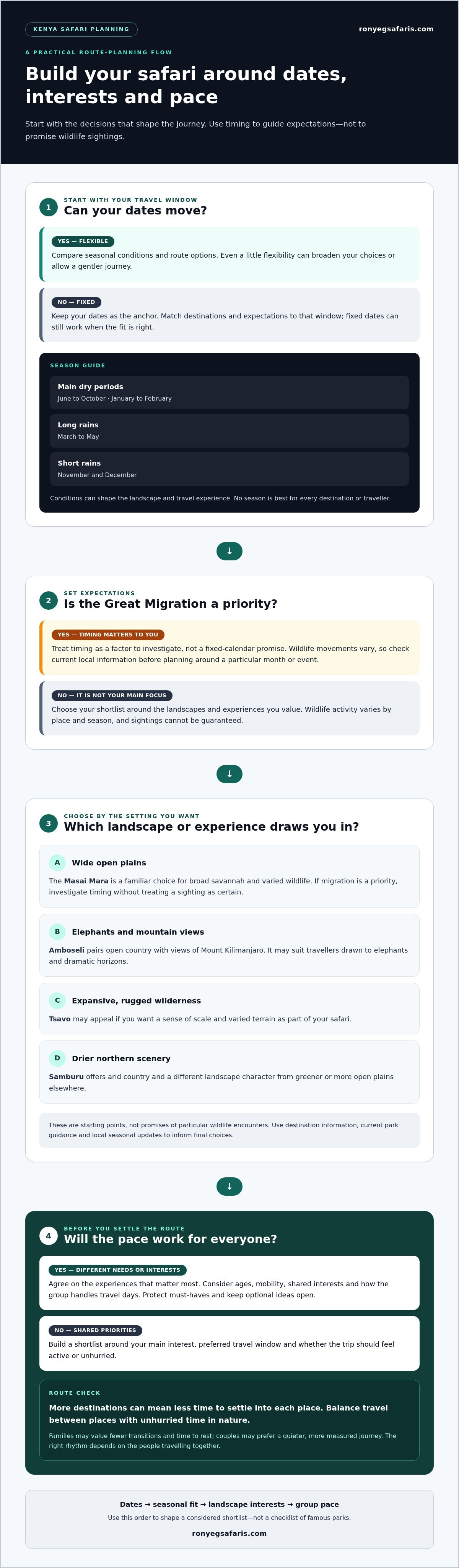
Separate firm dates from flexible ones. Work leave, school holidays, or a special occasion may narrow your window, while even a little flexibility can give you more options for seasonal conditions or a gentler route. Wildlife activity varies by place and season. Timing can guide expectations, but it cannot guarantee a particular sighting.
Which planning decisions should come first?
Set the travel window and trip length first, then note who is travelling and what matters most to the group. A strong interest in wildlife, a wish to spend quiet time in the landscape, or a preference for varied experiences will each point to different choices. These are planning anchors, not a final destination list.
- Dates and duration: Mark what cannot change and where you have flexibility.
- Group needs: Consider ages, mobility, shared interests, and how everyone handles travel days.
- Main interests: Distinguish wildlife priorities from cultural encounters, rest, or time by the coast.
- Must-haves and options: Protect the experiences that matter most, then keep optional ideas open.
Different groups often need different rhythms. Families may value fewer transitions and time to rest; couples might prefer a quieter, more measured journey; solo travellers and small groups may want a different balance of shared activities and flexibility. These are starting points, not rules. The right pace depends on the people travelling together.
How much should you plan before choosing destinations?
Build a shortlist of priorities before selecting every park. Write down your preferred travel window, the kind of landscape or wildlife experience you are drawn to, and whether you want an active or unhurried trip. This makes it easier to compare destinations against your actual needs instead of adding places simply because they are well known.
Leave some room around the edges. If your dates are flexible, consider how that could broaden your options. If the group has mixed interests, agree on the experiences that matter most before adding optional stops. A long list can look appealing on paper but leave little time to settle into each place. Build the day-by-day itinerary after these priorities are clear.
A well-paced safari balances time spent travelling between places with enough unhurried time in nature to experience each setting. Let that principle guide your first choices. A Kenya safari planning guide is most useful when it turns your dates, interests, and group needs into a journey with room to breathe.
Match Kenya Safari Destinations and Seasons to Your Interests
Once your travel window and group rhythm are clear, compare destinations by the kind of setting you want to experience. Kenya’s landscapes range from open grassland to mountain-framed plains and dry northern country. A useful shortlist connects those differences to your interests, rather than treating every well-known name as a required stop.
Which Kenyan landscapes and wildlife experiences appeal to you?
Use these examples as starting points, not promises of particular wildlife encounters. Each destination offers a different sense of place, and the experience also depends on your dates and how much time you allow for the journey.
- Wide open plains: The Masai Mara is a familiar choice for travellers drawn to broad savannah and varied wildlife. If migration is a priority, treat timing as a factor to investigate, not a guarantee of a sighting.
- Elephants and mountain views: Amboseli pairs open country with views of Mount Kilimanjaro. It may suit travellers drawn to elephants and dramatic horizons.
- Expansive wilderness: Tsavo’s broad, rugged landscapes may appeal to those who want a sense of scale and varied terrain as part of their safari.
- Drier northern scenery: Samburu offers a different landscape character, with arid country that may suit travellers seeking contrast with greener or more open plains elsewhere.
These broad distinctions help you compare the feel of a route before narrowing down specific parks or reserves. The official Kenya Tourism Board is a useful starting point for destination information. Use current park guidance and local seasonal updates to inform final decisions.
How should season shape safari planning?
Consider season alongside your interests, available dates, and preferred pace. Kenya’s main dry periods are generally June to October and January to February, while the long rains usually fall from March to May and the short rains in November and December. Conditions can affect the landscape and travel experience, but no season is best for every destination or traveller.
For the Great Migration, avoid relying on a fixed calendar promise. Wildlife movements vary, so check current local information before building a journey around a particular month or event. A flexible travel window may give you more options. Fixed dates can still work well when the destination and expectations suit them.
Choose destinations according to your interests, dates, and trip pace, not a checklist of famous parks. A Kenya safari planning guide is most useful when it helps you weigh those three elements together. Tailor-made Kenya safari planning brings destination choices into a coherent journey built around your priorities.
Compare Safari Priorities Before Building the Journey
A safari can hold several kinds of meaning: close attention to wildlife, shared family discoveries, time with local culture, or a change of scene by the coast. You can combine priorities, but each addition uses time that might otherwise be spent settling into one place. There is no universal best mix. The right balance depends on what you want to remember and how you want the days to feel.
How do you balance wildlife time with variety?
For a wildlife-led journey, focus on the places and habitats that matter most to you, allowing enough time for repeated outings and unhurried observation. Fewer stops can reduce time spent transferring between locations and give you more opportunity to become familiar with one landscape. Sightings remain unpredictable, so build the itinerary around the experience of being there, not a promise of what may appear.
Adding a coastal stay or cultural experience changes the shape of the journey. It can bring welcome contrast, but it also takes days to enjoy another setting and travel to it. If the coast is a must-have, include it from the outset rather than squeezing it into the final days. When deciding whether to add a destination, weigh the experience it offers against the time needed to reach it and enjoy it. The key question is whether variety or deeper time in fewer places matters more to you.
Which experience choices are right for your group?
Compare possible activities against the group’s ages, energy, shared interests, and preferred daily rhythm. A dawn game drive may suit travellers eager to head out early, while others may prefer a slower start or fewer scheduled outings. Optional experiences should add meaning, not pressure.
- Wildlife-led days: Make game drives the central activity if time in the field is the group’s shared priority.
- A special perspective: A balloon safari may appeal to travellers seeking a different view. Make sure its timing and suitability fit the group and itinerary.
- Cultural connection: A village visit can offer a chance to learn through respectful, locally guided exchange. Choose it for genuine interest, not as a box to tick.
- Slower moments: A bush breakfast may suit a group that values a pause in the setting, provided it fits the day’s plans.
Families may need room for rest and changing energy levels; couples may want a balance between shared activities and quiet time. Friends or multigenerational groups can name one shared priority, then decide which optional experiences are worth adding. No activity needs to suit every traveller.
A practical way to decide is to place each experience in one of three categories: essential, welcome if it fits, or leave out. This keeps the itinerary from becoming a catalogue of possibilities. A Kenya safari planning guide should help you make those trade-offs with care. Ronyeg’s tailor-made Kenya safaris can bring together the wildlife, culture, family needs, and coastal time that matter to your group.
Turn Your Kenya Safari Ideas into a Practical Plan
Once your priorities are clear, put them in an order that turns inspiration into decisions. A practical plan does not require every detail to be settled at once. It should make the important choices visible, show what the itinerary includes, and leave enough time to review current travel guidance before departure.
What should a planning checklist include?
Work through these steps in sequence. Each one gives the next decision a firmer foundation.
- Write down your travel dates and trip length. Mark which dates are fixed and note any flexibility that could affect the route.
- Record the group’s needs. Include ages, mobility considerations, shared interests, and the daily rhythm that feels comfortable.
- Set priorities and shortlist destinations. Separate essential experiences from optional ones, then choose a manageable set of places that supports them.
- Review the proposed itinerary. Read what is included, such as accommodation, activities, transfers, and the sequence of travel days. Note exclusions too, so you understand the full arrangement.
- Check documents and current guidance. Most visitors need to review Kenya’s entry requirements before travelling. Use the official Kenya eTA portal for current application guidance, and consult a qualified health professional and relevant official public-health advice about health preparation for your circumstances.
- Read the quotation alongside the itinerary. Look for clear pricing and a plain explanation of inclusions, exclusions, and assumptions. Consider whether the proposed arrangement reflects your priorities instead of comparing totals without context.
Entry and health guidance can change, and requirements may differ by traveller. Check official information close to your planning and departure dates rather than relying on an old checklist. A Kenya safari planning guide can help you organize the questions, but current requirements come from the relevant authorities.
How can you keep the safari from feeling rushed?
Review the itinerary for the balance between movement and time in each place. Travel days and activity days both take up time, and a route with many stops may leave less room to settle into a landscape. If every destination is marked essential, return to your priority list and decide which experience deserves the greatest share of the journey.
Check whether the daily pattern suits your group, too. A full schedule may appeal to travellers eager to be active, while families or mixed-age groups may value breathing room between outings. Check that the proposed journey gives your main priorities enough time, and that travel between destinations does not crowd out the experiences themselves.
Ronyeg Kenia Tours and Travels is a Kenyan-owned Destination Management Company that coordinates journeys on the ground and designs tailor-made Kenya safaris and beach holidays around travellers’ dates, budget, and pace. Explore a tailor-made Kenya safari shaped around the experiences that matter to you.
Plan Your Kenya Safari with a Local On-the-Ground Partner
After comparing destinations and deciding what matters most, bring those choices into a journey that works in practice. A Kenyan-owned Destination Management Company understands the local context behind the route and coordinates the arranged journey on the ground. Local coordination can connect wildlife destinations, travel days, and a beach stay when it suits your priorities, while keeping the itinerary centred on your preferred pace.
What does local itinerary coordination add?
Planning is more than placing destinations in sequence. Your dates, interests, group needs, and available time all shape how the journey fits together. Ronyeg Kenia Tours and Travels designs tailor-made Kenya safaris and beach holidays around those details, coordinating the journey on the ground so its parts support a considered route rather than a crowded checklist.
During arranged journeys, 24/7 guest support provides a practical point of reassurance as travel unfolds. It cannot make wildlife sightings or travel conditions predictable, but support is available throughout the journey. Clear US-dollar quotations also help travellers understand the proposed arrangement and its costs in a consistent currency. Read the quotation alongside the itinerary, paying attention to what is included and how the plan reflects your priorities.
Local coordination is especially useful when a journey brings together different settings, such as wildlife areas followed by a coastal stay. Each transition needs to make sense within your dates and preferred pace. A Kenyan-owned team working on the ground can shape those elements with local knowledge, keeping the arrangement focused on the safari and holiday you are planning.
How can you take the next planning step?
Begin with a simple outline: your travel dates, who is travelling, the experiences that matter most, your preferred pace, and your budget. You do not need a finished route. These details give the itinerary a sound starting point and help distinguish essential experiences from options to consider as the plan develops.
Ronyeg uses those priorities to shape a tailored itinerary and provides clear pricing in US dollars, so you can review the proposed journey with its arrangements in view. Consider whether the destinations, transitions, and activities suit your group, and whether the overall pace leaves room to experience each setting.
A well-made safari plan should reflect your reasons for travelling, with practical coordination supporting the time spent in Kenya’s landscapes. If you are ready to put your ideas into a tailored journey, begin planning your Kenya safari with Ronyeg.
Let Your Safari Plan Take Shape
The best journeys leave room for the landscape to set its own pace. As you move from ideas to arrangements, keep one guiding question in view: does this plan give you enough time to experience what matters? A useful Kenya safari planning guide does not dictate a single route. It helps you make considered choices and lets your priorities lead.
Ronyeg is a Kenyan-owned, on-the-ground Destination Management Company, with 24/7 guest support during journeys and clear US-dollar pricing for travellers. Share your dates, travel party, and the experiences you hope to carry home, and the team can shape a tailor-made journey around them. Begin planning your Kenya safari with Ronyeg.
Frequently Asked Questions
When is the best time to plan a Kenya safari?
There is no one best time for every Kenya safari. The right window depends on your destinations and interests. Kenya has dry periods and rainy seasons, which can affect the landscape and wildlife patterns. If you hope to see a particular seasonal event, treat it as a planning consideration rather than a certainty. Check current local guidance before settling on dates, especially if one wildlife experience is central to your plans.
How many days should I allow for a Kenya safari?
The right duration depends on how many places you want to visit and how much time you would like in each. A trip that includes several wildlife areas and a coastal stay needs more room than a journey focused on one region. Name your essential experiences first, then consider how travel between them affects the time available. A shorter list of priorities can help keep the itinerary comfortable.
Can I combine a Kenya safari with a beach holiday?
Yes, a Kenya safari can be paired with time on the coast. The combination works best when you allow for the transition between inland wildlife areas and the beach, rather than fitting the coast into leftover days. Consider whether you want the shoreline as a restful close to the trip or as an equally important part of it. Ronyeg designs tailor-made safari and beach holidays around travellers’ priorities.
What should I decide first when planning a Kenya safari?
Decide your travel dates, who is travelling, and the experiences that matter most before narrowing down destinations. A group with varied interests, for example, may want to agree on one shared priority, then leave room for individual preferences. Note which dates are fixed and which can move. This Kenya safari planning guide approach helps you compare options with a clear purpose instead of trying to fit every appealing idea into one journey.
Is the Great Migration guaranteed during a Kenya safari?
No, the Great Migration and any specific wildlife sighting cannot be guaranteed. Animal movements and river crossings are shaped by natural conditions, so their timing can vary. If the Migration is important to your trip, use current local guidance to inform your travel window and expectations. Value the wider experience of the landscape and other wildlife, too, so the journey does not depend on a single event.
Do I need to book a Kenya safari through a local operator?
No single planning route suits every traveller, but a local operator can coordinate safari arrangements on the ground. Ronyeg Kenia Tours and Travels is a Kenyan-owned Destination Management Company that designs and operates tailor-made journeys. Its itineraries include road and air travel, allowing the route to be shaped around the trip’s needs. Share your interests and travel party to start planning a journey that fits.


