

The best Kenya safari by road may be the one that covers less ground. A map can make the distance between parks look simple, but transfer time, stops and the time needed to settle in all shape what you’ll actually experience. It’s natural to want to see more; the key is choosing a pace that leaves room for wildlife, not just the next destination.
Whether a guided tour or self-drive suits you depends on how much freedom you want behind the wheel and how much planning you’d rather leave to someone who knows the country’s roads. This guide compares the two approaches and their practical trade-offs, so you can choose what fits your comfort and travel style.
You’ll also find ways to build a realistic route, balance transfer days with time in the parks, and shape the journey around your dates and priorities. Ronyeg Kenia Tours and Travels is a Kenyan-owned, on-the-ground destination management company that coordinates tailor-made Kenya safaris, with routes and pacing shaped around each journey.
Key Takeaways
- Think of a road safari as a journey between wildlife areas, where changing landscapes and transfer time shape the experience.
- Look beyond map distance when setting your pace. Stops can affect arrival time, energy and time available for game viewing.
- Compare guided travel and self-drive by how much independence, planning and local coordination you want.
- Build your Kenya safari by road around your priorities, trip length and destinations before deciding how much ground to cover.
- See how a Kenyan-owned operator can shape a tailor-made itinerary around your dates, budget and preferred pace.
Kenya Safari by Road: What the Journey Really Involves
A road safari links wildlife destinations by vehicle, making the land between parks part of the journey rather than a gap to cross. The view shifts as the route unfolds, from cultivated ground and distant hills to open plains and changing light. A wildlife sighting may begin before you reach a reserve, but time on the road also takes time away from game viewing at your destination.
The word “safari” has a broader history and meaning, outlined in What is a Safari?. In Kenya, a road-based safari brings the journey itself into focus. It offers a sense of geographical connection, while requiring you to make room for transfers as well as time in the parks.
A road safari connects destinations through the landscape; a fly-in safari relies chiefly on air travel between them.
What makes a road safari different from a fly-in journey?
On the road, destinations connect through changing scenery and the details of travel, such as a town along the way, a stretch of highland or the first open view of the plains. Flying can reduce overland transit, while a road route makes that transition part of the experience. The right option depends on how you want to use your time. A later road-versus-air comparison explores that transport decision in greater depth.
Who is likely to enjoy travelling through Kenya by road?
Travellers who value continuity between destinations, varied landscapes and a gradual sense of place may find the road especially rewarding. The ideal pace varies by group. Families may want room for breaks and different energy levels; couples might prefer fewer stops and longer stays; solo travellers and small groups may have their own balance of independence, shared time and comfort.
Before choosing a road itinerary, consider the practical shape of your holiday:
- Mobility and comfort: Think about how extended vehicle journeys fit your needs and what would make travel comfortable for everyone in your party.
- Available time: A shorter holiday leaves less room for long transfers. More days can allow a gentler pace and fuller stays at destinations.
- Preferred independence: Decide whether you want to shape the journey as you go or have the ground arrangements coordinated around your priorities.
The right route is not simply the one with the most destinations. It is the one that balances the journey, your comfort and your time for wildlife.
How Road-Safari Pace Shapes Wildlife Time and Comfort
A line on a map measures distance, not the shape of a travel day. The route may pass through towns, vary in surface or elevation, or call for pauses along the way. Conditions also vary, so a transfer that looks manageable on screen can feel demanding once you account for time in a vehicle and the energy needed after arrival. For a Kenya safari by road, plan around the journey itself, not just the kilometres between places.
Stops can make a travel day more comfortable, but they also affect when you reach your next stay and how much time remains to settle in or view wildlife. A brief pause to stretch is different from adding another destination. Each extra stop takes time and energy, so weigh it against what you hope to experience at the places already on your route.
How many destinations can a road safari comfortably connect?
There’s no fixed number. It depends on your trip length, route and how much time you want in each destination. For example, combining Maasai Mara National Reserve and Amboseli National Park means accounting for the overland connection as well as the different landscapes and wildlife experiences at both. A route-specific itinerary should reflect the actual logistics, rather than rely on a rough map estimate.
Before settling on the sequence, review the road plan and expected transfer arrangements for your dates. Kenya’s travel conditions can change, and the U.S. Department of State’s Kenya Travel Safety and Road Conditions page offers practical context to consider alongside local itinerary planning.
How to recognise an itinerary that feels too rushed
Frequent one-night stops and repeated long transfers are signs to reconsider the balance. Unpacking and repacking can leave little time to settle in, while arriving tired may make an afternoon in the park less appealing. Leave space for rest, changing conditions and the unhurried rhythm of game viewing, where a sighting may call for patience rather than a quick stop.
A realistic road day leaves you with energy for the safari, not only enough time to reach the next bed. When comparing itineraries, look at the pattern of travel and stays together. Several destinations may be possible, but fewer stops can mean more time to explore each one. Check how many nights you’ll spend in each place and whether transfer days leave room for the experiences you value.
Ronyeg Kenia Tours and Travels shapes tailor-made journeys around your dates, destinations and preferred pace, with local coordination informing the ground itinerary. A useful first step is to explore tailor-made Kenya safaris and consider how much of your holiday you want to spend travelling between places.
Guided Kenya Road Safari vs Self-Drive: Which Fits You?
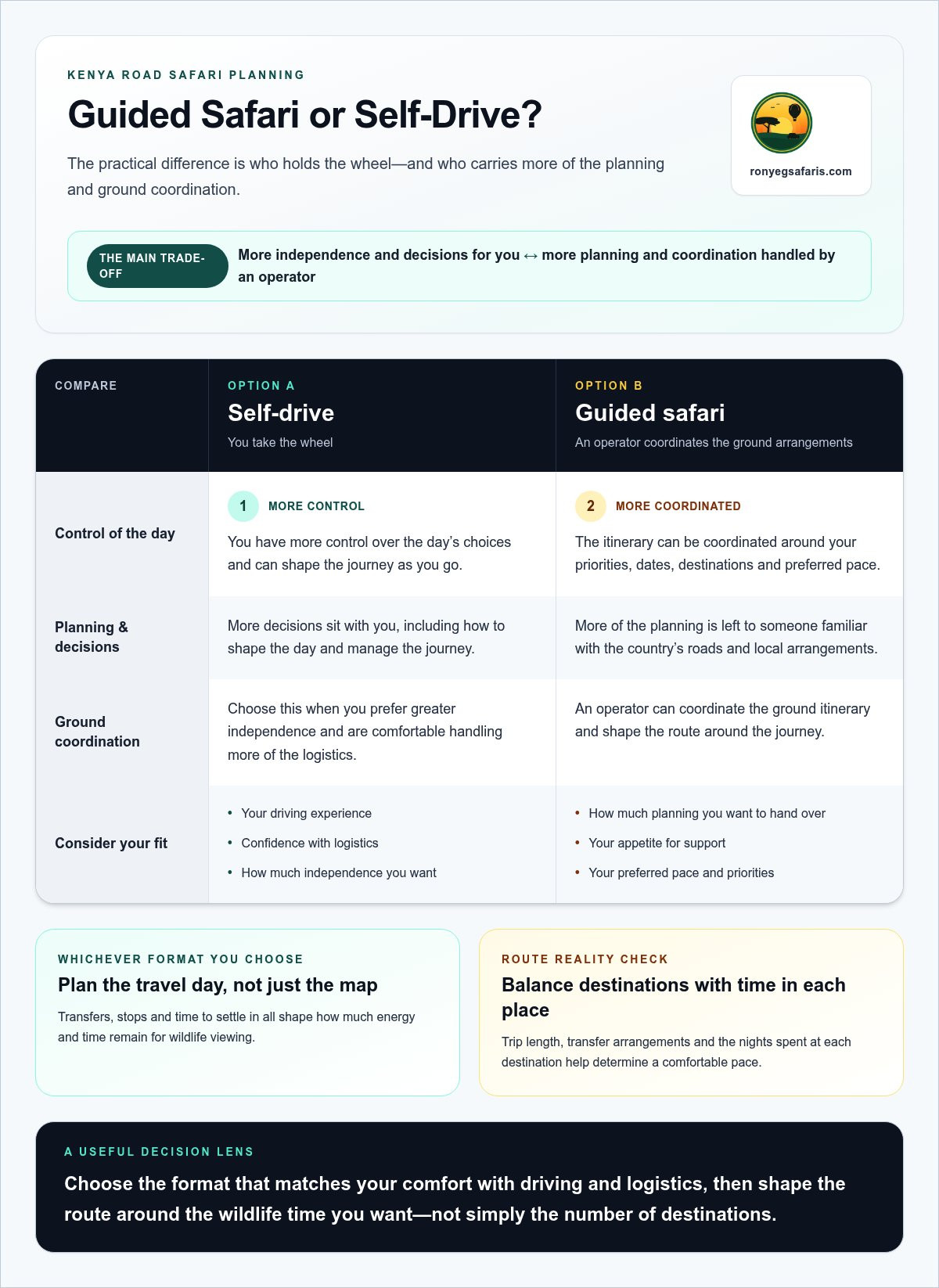
Both formats can take you between Kenya’s wildlife destinations by road, but they place different responsibilities in your hands. Self-drive gives you more control over the day’s choices; a guided itinerary leaves more of the planning and ground coordination to an operator. Neither suits every traveller. Your driving experience, confidence with logistics, preferred level of independence and appetite for support all matter.
Self-drive puts more decisions in your hands; a guided safari brings more of the ground journey under coordinated support. Compare the practical differences before choosing.
| Consideration | Self-drive | Guided road safari |
|---|---|---|
| Independence | You decide how to manage the day’s stops and travel rhythm within your itinerary. | The journey follows a planned arrangement, shaped around your dates and preferred pace. |
| Logistics | You take responsibility for navigation, stops and coordinating each part of a multi-destination trip. | Ground arrangements are coordinated as part of the safari plan. |
| Planning effort | Requires more preparation and active decision-making during the journey. | Leaves more of the route and practical coordination to the operator. |
| Local coordination | You manage the journey independently. | A locally operated itinerary connects the different ground arrangements. |
When self-drive may suit your travel style
Self-drive can appeal if you enjoy making your own travel decisions and want to set an independent rhythm. You’ll need to plan how to navigate, where to pause and how each transfer fits the wider route. That responsibility can feel rewarding to confident travellers, but your experience behind the wheel should be considered alongside the demands of the route and the needs of everyone travelling with you.
When a locally operated guided road safari may suit you
A locally operated guided safari may suit you if you’d rather have the ground journey coordinated around your dates, destinations and preferred pace. Ronyeg Kenia Tours and Travels designs tailor-made Kenya safaris and provides 24/7 guest support, with local coordination connecting the arrangements across the journey. The best fit depends on how much support you want alongside the freedom to experience the trip.
Consider what you want to manage yourself and what you would rather have coordinated. If planning each transfer is part of the pleasure, self-drive may feel natural. If you’d prefer to focus on the landscapes and wildlife while an operator coordinates the itinerary, a guided trip may suit you better. Either way, a Kenya safari by road should reflect your confidence and travel style, not someone else’s account of what worked for them.
Plan a Kenya Safari by Road Around Your Priorities
A thoughtful road itinerary begins with what you want to experience, not with a long list of places to fit into the calendar. Wildlife interests, cultural experiences, time on the coast and the hours you’re comfortable spending on the road all shape the route. Use this sequence to turn your preferences into a practical plan.
- Define your priorities. Decide whether wildlife viewing is the main focus, or whether you also want cultural experiences, varied landscapes or time by the coast. Naming what matters most makes it easier to choose what belongs in the itinerary.
- Set your trip length. Work from the days you have, including arrival and departure arrangements. The time available affects how many destinations can fit without making travel the main activity.
- Choose destinations. Select places that match your interests and consider how they connect by road. Nairobi may be an arrival or departure point, but it doesn’t have to anchor every route.
- Assess the pace. Look at the full sequence of stays and transfers. Decide how much time you want for game drives and rest, then adjust the number of stops to suit.
Choose destinations before adding stops to the route
Each destination brings a different character to the journey. Maasai Mara may appeal for its open grasslands and wildlife focus; Amboseli for its landscape beneath Mount Kilimanjaro; Tsavo for its broad wilderness; Samburu for its distinct northern setting. Choose for the experience you value, then consider how the places fit together. A Kenya safari circuit guide can help you explore combinations and route details without treating every stop as essential.
If your plans include a coastal stay, allow it to shape the route rather than attach it as an afterthought. The same applies to cultural experiences: consider where they fit naturally with your chosen destinations and available time.
Set a pace that leaves room for the experience
Be clear about the balance you want between game drives and road transfers. If time in the parks and a more comfortable rhythm matter most, fewer, well-spaced stops may serve you better than a route crowded with destinations. To assess the pace, count the transfer days and nights in each place, then consider whether the itinerary leaves enough time for the activities you want.
Keep the plan flexible enough to reflect your travel style and priorities. Ronyeg Kenia Tours and Travels can shape a tailor-made safari around your dates, budget, preferred pace and destinations. Plan a tailor-made Kenya safari around the experiences you want most.
How Ronyeg Plans a Tailor-Made Road Safari in Kenya
A road safari takes shape through the details that matter to you: your travel dates, the places you hope to see, the pace that feels comfortable and the budget guiding your choices. Ronyeg Kenia Tours and Travels is a Kenyan-owned Destination Management Company that designs and operates tailor-made Kenya safaris, coordinating the ground journey around those priorities rather than treating every itinerary as the same sequence of stops.
Local coordination connects the broad idea of a trip with the practical shape of its route. The aim is to plan a journey with a clear rhythm, allowing the selected destinations and the time available to work together.
What tailor-made road-safari planning can account for
Planning begins with your interests and the time you have. Wildlife may be your central focus, or you may want cultural experiences alongside time in the parks. A beach stay can also influence how the road journey is arranged. These priorities help guide destination selection, the order of travel and the balance between moving on and staying longer.
Dates and budget matter, too. They provide a framework for shaping the itinerary and its pace, while your preferred style of travel helps determine what feels manageable. There is no single set of parks, activities or accommodation that belongs in every safari. The plan is tailored to the journey you want to take.
Begin planning your Kenya road safari with Ronyeg
To begin, share your travel dates, who is travelling, the experiences that interest you and how you prefer to spend a travel day. It also helps to describe the balance you have in mind, whether that means focusing on wildlife, including cultural experiences or making room for the coast. These details give the itinerary a useful starting point.
Ronyeg provides 24/7 guest support and clear US-dollar quotations as the ground arrangements come together. The quotation is presented in US dollars, while the planning reflects the dates, budget and destinations shaping your trip. As a Kenyan-owned operator, Ronyeg brings on-the-ground coordination to the work of connecting each part of a tailor-made safari.
A well-planned Kenya safari by road should feel considered from the first destination to the last, with a pace that leaves space for the experiences you value. Share your plans with Ronyeg to start shaping a tailor-made road safari in Kenya around your journey.
Let Your Journey Take Shape
The road through Kenya is more than a way to move between places. It can become part of how you remember the country: the changing light, the widening horizon and the gradual shift from one landscape to another. Let that possibility guide your plans, alongside the practical limits of your time and the kind of travel that feels right to you.
Before you plan the route, choose the experience you most want to carry home. That priority can help bring the shape of your Kenya safari by road into focus, from the destinations you include to the rhythm you give each day. A journey designed around what matters to you can feel more meaningful than one built simply to cover more ground.
Share your ideas and begin shaping the journey with Ronyeg’s tailor-made Kenya safari planning. Start with the route and landscapes you’re most eager to discover.
Frequently Asked Questions
Is a guided Kenya safari by road better than self-drive?
A guided safari is often a better fit if you’d rather not manage every ground arrangement yourself, while self-drive suits travellers who enjoy making independent decisions. Consider what you’re comfortable handling, including route choices, daily plans and changes along the way. If you want to adjust the day around your group’s energy, decide whether you’d prefer to do that independently or have your itinerary coordinated with local support.
How long should a Kenya road safari be?
The right duration depends on your route and how much time you want to spend in each place. A useful planning exercise is to mark the days you have, then allow for arrival and departure before choosing destinations. If you also want a coastal stay, include that time from the start. This helps reveal whether the route gives you meaningful time in each place or asks you to move on too quickly.
Is travelling between Kenya's safari parks by road tiring?
It can be, depending on the route, travel schedule and your comfort with extended time in a vehicle. A day that combines a transfer with settling into a new stay may feel different from a day set aside for game viewing. Look at the pattern across the whole itinerary: repeated accommodation changes can add effort, while a rest period or longer stay can give you time to recover.
Can a Kenya road safari include both wildlife and the beach?
Yes, a tailor-made Kenya journey can combine wildlife destinations with a coastal stay. The balance depends on your dates, interests and route, so decide how much time you want in the bush, on transfers and by the sea. Ronyeg Kenia Tours and Travels plans safari and beach holidays across Kenya. A Masai Mara and Diani combination, for instance, can bring open savannah and the coast into one broader trip plan.
What is the difference between a self-drive and guided road safari in Kenya?
With self-drive, you manage the driving decisions and practical trip logistics yourself; with a guided road safari, the ground journey is coordinated with a local operator. This distinction affects more than who is behind the wheel. Consider who will handle route adjustments, how much preparation you want to do and whether you prefer to make spontaneous choices or travel within an arranged plan.
Which places can I visit on a Kenya safari by road?
Road itineraries can include places such as Maasai Mara National Reserve, Amboseli, Tsavo East, Tsavo West or Samburu. The right combination depends on your interests and how much time you have. Rather than trying to visit every park, choose destinations for the experiences they offer. Pairing two contrasting settings may suit you better than spending much of your trip moving between several stops.
Can a Kenya road safari be tailor-made for families or small groups?
Yes. Ronyeg plans tailor-made journeys for families, small groups, couples and solo travellers. A family itinerary can take account of different interests and preferred daily rhythms, while a group may want to agree on shared priorities before selecting destinations. Share your dates, budget and interests so the route and time in each place can reflect the people travelling together.
How do I start planning a Kenya safari by road?
Start with your dates, group size and the experiences you most want from the trip. Note whether wildlife, cultural visits or a coastal stay matters most, then consider how much time you want to spend travelling between destinations. Ronyeg can use those details to shape a tailor-made Kenya journey and provide a clear US-dollar quotation. A focused outline of your priorities is a practical first step.


