

The cost of Kenya safari packages depends on your travel dates, route, transport, accommodation, and activities. There is no single price for every itinerary: a focused stay in the Maasai Mara differs from a longer trip combining several destinations. Start by identifying your priorities, then compare what each itinerary includes.
Choosing a safari also means finding a pace that leaves room for the landscape, not just moving between destinations. This guide explains what shapes safari costs, how to choose a trip length and season, and what to expect from the Maasai Mara, Ol Pejeta, and other wildlife areas. You’ll come away with a clearer sense of which route and travel window suit the experience you have in mind.
Key Takeaways
- Compare itineraries by route, transport, accommodation, and included activities, not by the headline price alone.
- Choose the Maasai Mara for its open savannah and migration season, or consider Ol Pejeta as part of a wider wildlife route.
- Allow enough days for the parks you want to visit, while accounting for the time spent travelling between them.
- Match your travel season to your priorities, whether that means dry-season wildlife viewing, migration timing, or a quieter, rainier period.
- Use a tailor-made itinerary to bring your preferred destinations, pace, and comfort level into one coherent safari plan.
What does a Kenyan safari cost?
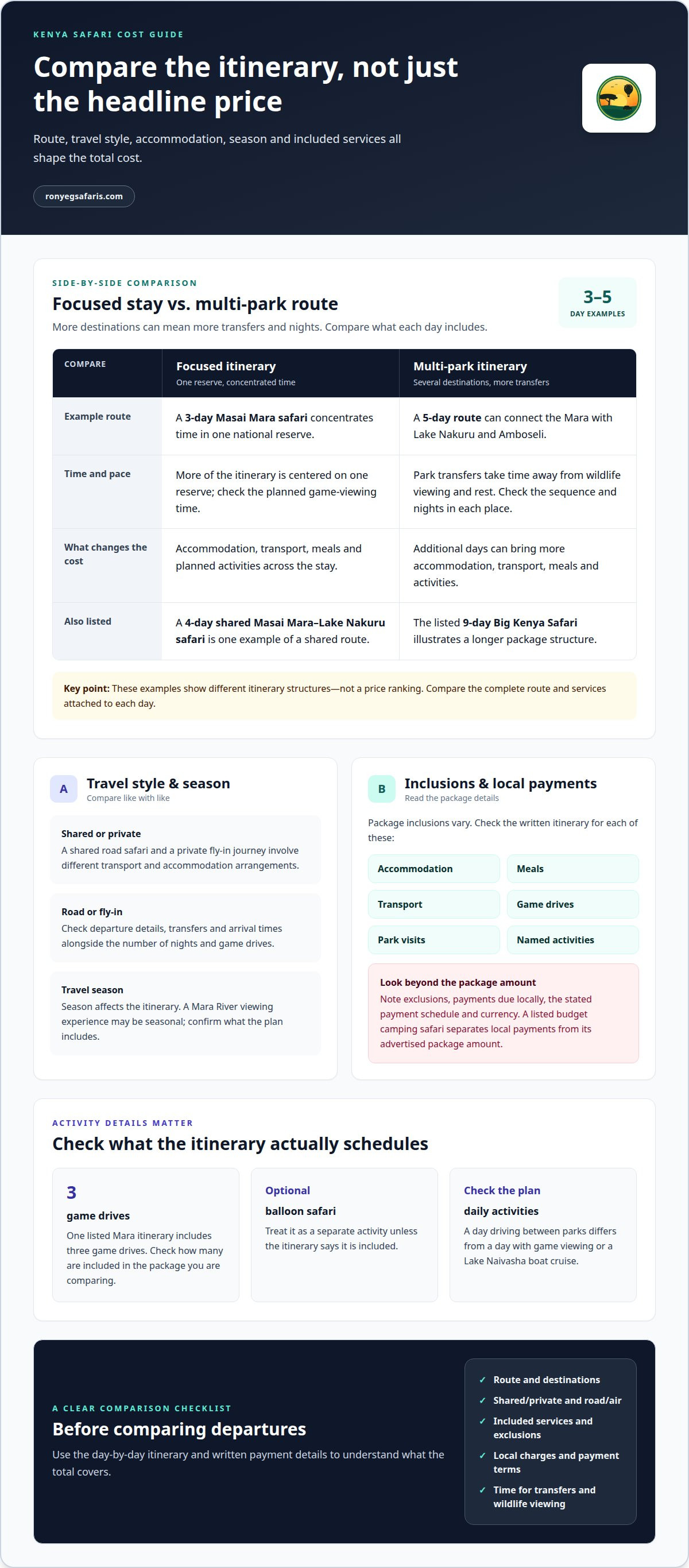
There’s no single cost for a Kenyan safari: route, travel style, accommodation, season, and inclusions all affect the total. Compare the complete itinerary and payment terms, not just an advertised starting price.
Starting Prices and Departures
Starting prices can differ because a shared road safari and a private fly-in journey involve different transport and accommodation. Departure dates and season also shape the itinerary. Compare destinations, group arrangements, and inclusions. For a tailor-made safari, the price depends on your plans and is provided in a clear quotation.
A shared Masai Mara and Lake Nakuru itinerary, for example, differs from a private trip to Lake Nakuru. Check the departure details and day-by-day route before comparing options. A Mara River viewing experience may be seasonal, while other activities can shape the itinerary differently.
Package Length and Price
Duration affects cost because additional days bring more accommodation, transport, meals, and planned activities. A 3-day Masai Mara safari concentrates time in one national reserve, while a 5-day route can connect the Mara with Lake Nakuru and Amboseli. Longer trips may add more park transfers and nights, so compare both the itinerary and the services attached to each day.
Ask what each travel day involves. A day spent driving between parks differs from a day with game viewing or a boat cruise at Lake Naivasha. The listed 9-day Big Kenya Safari and 4-day Masai Mara-Lake Nakuru shared safari illustrate how trip length and route produce different package structures. Match the duration to the wildlife viewing you want, not simply the number of destinations.
Included Services and Local Payments
Package inclusions vary. Read the itinerary for accommodation, meals, transport, game drives, park visits, and named activities. Note exclusions and any payments due locally. One listed Kenya budget camping safari separates local payments from its advertised package amount, showing why the headline figure may not reflect the full trip expense.
Before comparing departures, make a checklist of included services and local charges. Note whether the itinerary names game drives, a balloon safari, or a village visit, and whether meals are specified. This makes differences clear without assuming every package covers the same activities. Check the stated payment schedule and currency before choosing.
Package Types and Operator Choice
Kenya safari packages include shared and private trips, road and fly-in itineraries, and camping, mid-range, or luxury stays. Some focus on one reserve; others combine destinations such as Maasai Mara, Lake Nakuru, and Amboseli. When choosing an operator, compare the route, written inclusions and exclusions, departure details, and payment breakdown.
Ask how the itinerary handles transfers and wildlife viewing time, then compare the answer with the day-by-day plan. A 4-day shared route and a private multi-park adventure serve different needs. For packing, bring light layers in neutral colours, closed-toe shoes, a hat, sunglasses, sunscreen, insect repellent, and a small day bag. Road and air departures can have different luggage arrangements, so follow the allowance provided for the selected trip.
Maasai Mara and Ol Pejeta destinations
The Maasai Mara and Ol Pejeta offer distinct safari experiences, and each shapes the route differently. The Mara is known for migration-season viewing, while Ol Pejeta can feature in a wider itinerary with Lake Nakuru and the Mara. Compare time in each destination, transfers, and activities before choosing.
Maasai Mara: migration and game drives
The Maasai Mara is closely associated with the Great Migration. The migration season is described as running from July to September, while July to October is identified as a prime wildlife-viewing period. These are useful planning windows, not a promise of a river crossing on a particular day. Your season and route shape what you may see.
Game drives are a central way to explore the reserve. One listed itinerary includes three game drives, offering several outings rather than a single brief visit. Check how many drives are included and whether the itinerary gives you time to explore different areas. Maasai Mara and Masai Mara are both common spellings, so itineraries may use either.
Fly-in access and balloon safaris
For a fly-in Masai Mara safari, flights from Nairobi’s Wilson Airport depart twice daily. Flying replaces a long road transfer with an air connection, but the itinerary still needs to account for arrival and departure times. Compare the flight schedule with the number of nights and game drives, so travel does not crowd out time in the reserve.
A hot-air balloon safari is an optional addition on some Mara itineraries. It offers a different viewpoint from vehicle-based drives, but should be treated as a separate activity rather than assumed to be included. Consider how it fits alongside scheduled drives and other plans. A Maasai village visit is another activity to look for if cultural experiences matter to you.
Adding Ol Pejeta to the route
Ol Pejeta can anchor a broader itinerary rather than a Mara-only stay. A listed seven-day route combines Ol Pejeta, Lake Nakuru, and the Masai Mara, illustrating how several destinations can fit into one journey. The practical question is how to divide your time: transfers compete with time for wildlife viewing and rest.
Compare routes by the sequence of parks, nights in each destination, and activities included, not simply by the number of names on the itinerary. If you want the Mara alongside Ol Pejeta, a tailor-made Kenya safari can shape the route around those priorities.
Trip durations and recommended itinerary length
For Kenya’s key wildlife areas, a useful planning range is 6-8 days. The right itinerary depends on how many destinations you want and how much time you want for game viewing.
Choose a duration that fits the route
A typical 7-day route can allow 3 days in the Maasai Mara, 2 days at Lake Nakuru or Lake Naivasha, and 2 days in Amboseli. This gives each area time in the schedule, rather than treating every park as a brief stop. If Amboseli needs 3 days, plan toward the longer end of the 6-8-day range.
For a shorter safari, focus on fewer destinations. Spending more time in one area can allow for repeated drives and a steadier pace. Adding another park also means accounting for its transfer and overnight stay. Review the day-by-day route before deciding whether the destinations fit your available days.
Build the itinerary around destinations
Start with the experience that matters most, such as wildlife viewing in the Maasai Mara or the landscapes around Amboseli. Then fit other destinations into the route according to your available time. Lake Nakuru and Lake Naivasha can each fill a two-day portion of a typical itinerary, but choosing between them changes the scenery and activities that shape your trip.
Count travel days as part of the itinerary, not as time outside it. Moving between parks takes time, so the number of destinations alone doesn’t show how long you’ll have for wildlife viewing. Check where each night falls and whether the schedule gives you time in the places you most want to experience.
Balance pace, nights, and accommodation
Accommodation shapes the rhythm of your route. Kenya safari stays commonly combine lodges and tented camps, and your itinerary should show where each overnight fits. Changing camps can bring you closer to another area, but frequent moves also mean more packing and transfers. Compare nights in each destination, not just the total trip duration.
Some tours extend beyond a week. One Kenya wildlife safari lasts 13 days, with an 18-day option that adds a Tanzania extension. That longer format suits travelers who want a broader journey across two countries; it also requires more time away and a route planned around both destinations. For a Kenya-only trip, the 6-8-day framework offers a practical starting point.
Use a simple planning sequence
Choose your priority park, allocate days to the other destinations, then review the order of travel. For example, a 7-day outline with the Maasai Mara, a lake stop, and Amboseli can be compared against the 13-day Kenya itinerary to see how much broader travel changes the pace. The best fit is the schedule that gives your chosen places meaningful time.
Kenya safari seasons
Season affects landscapes, wildlife viewing, and travel conditions across Kenya. Migration draws visitors to the Maasai Mara in particular months, while rainy and dry periods shape the experience in other parks.
Wildebeest Migration Season
The wildebeest migration season in the Masai Mara is described as running from July to September. July to October is also identified as a prime wildlife-viewing period, making those months important when planning a Mara itinerary. Migration is a natural movement, not a fixed daily event; your route and timing influence where you spend time.
For a migration-focused trip, make the Mara your anchor, then consider whether other parks fit your available days. Adding Lake Nakuru or Amboseli brings different landscapes and habitats, but also divides your time between destinations. Choose the season for the experience you value most, then build the itinerary around the Mara rather than expecting a guaranteed migration sighting.
Kenya’s dry season is described as July to October and January to March. These windows offer a different seasonal context from the rains, and January to March is also identified as a shorter dry season. When weighing a Mara trip against other parks, use the season to help decide which destination leads and how much time to spend there.
Rainy Seasons
Kenya’s longer rainy season runs from April to June, while the shorter rainy season runs from November to mid-December. April to June is also described as the most budget-friendly travel season. These patterns can guide your decision, but a suitable itinerary still depends on the destinations you want to visit and the experience you want in each landscape.
Rain changes the character of a safari, but each destination is different. Consider how your route connects the parks and allow enough time for planned activities rather than packing in too many stops. A traveler choosing the Maasai Mara during the migration window has different seasonal priorities from someone planning around January to March in Amboseli or Lake Nakuru.
December to February is identified as Kenya’s high season, while March, April, and May are described as the wet-season peak. Use these distinctions to compare dates and the pace you prefer. Start by choosing the wildlife or scenery that matters most, then match parks and travel days to it. Nairobi can be a starting point, but your season and route shape the journey beyond the city.
Kenya safari destinations and parks
Kenya’s parks are not interchangeable stops on a map. Each destination affects the route, travel time, and kind of day you plan. Choose based on the experience you value, then give each stop a purpose instead of collecting park names.
The Maasai Mara is a natural anchor for travelers focused on game drives and migration-season viewing. Pairing it with Lake Nakuru creates a different journey from staying in the Mara alone. A broader route might also include Amboseli or Ol Pejeta, but each added destination needs time for its transfer and stay.
For a more varied circuit, consider the parks and reserves on the route: Amboseli, Tsavo East, Tsavo West, Samburu, and Maasai Mara. These are different itinerary options, not a checklist to complete in one trip. Start with the park that matters most, then choose compatible stops based on your available days and preferred pace.
Nairobi National Park offers a distinct option close to the capital. It is a 15-minute drive from central Nairobi’s business district, making it a practical choice for travelers with limited time near the city. Treat it as a focused visit rather than a substitute for a longer circuit through Kenya’s national parks and reserves.
Compare destinations by noting each park’s place in the route, the nights assigned there, and the game drives included. Then consider what you hope to see, whether elephants, a range of wildlife, or migration viewing. An itinerary should also leave room for meals and rest. A bush breakfast, for example, is a specific activity to look for, not assume.
Ol Pejeta can be combined with Lake Nakuru and the Maasai Mara in a seven-day itinerary, showing how a multi-park route can connect distinct destinations. Compare that sequence with a Mara-focused plan. A clear order of destinations makes it easier to judge whether the journey gives enough time to each place.
Once your priorities are clear, plan a tailor-made route through Kenya’s parks around the destinations and experiences that matter most.
Ronyeg Kenia Tours and Travels: Tailor-made Kenya safaris
Ronyeg Kenia Tours and Travels designs tailor-made Kenya safaris around the parks, season, and pace you’ve chosen. Turn to the team when you want to connect destinations such as the Maasai Mara and Ol Pejeta in one considered route, or shape a journey around a particular wildlife experience. Safari packages and Festive 2026/27 safaris are also available, while travel-trade ground partner services support travel professionals planning Kenya itineraries.
Share your preferred travel period, destinations, and accommodation style to start shaping your itinerary. Ronyeg Kenia Tours and Travels provides clear US-dollar quotations for tailor-made Kenya safaris and beach holidays. To plan a route around your priorities, visit ronyegsafaris.com or email [email protected].
Set your safari priorities in motion
Start by deciding how you want the journey to feel, then let that guide the practical choices. You might value unhurried mornings, a particular landscape, or time to experience each place beyond the vehicle. Naming that priority gives your itinerary a clear focus and helps keep planning decisions aligned.
When planning Kenya safari packages, bring your preferred travel period, pace, and must-see experiences into the conversation. Ronyeg Kenia Tours and Travels can shape those priorities into a tailor-made journey, including festive travel options. Travel professionals can also work with the company as a ground partner.
Contact Ronyeg Kenia Tours and Travels to begin shaping your journey. Kenya’s open horizons are waiting, and a thoughtful plan is a good place to start.
Frequently Asked Questions
When is the best time to visit Kenya?
The best time depends on whether you prioritize dry conditions, migration viewing, or a quieter travel period. For photography, consider how seasonal light and vegetation may affect the landscapes you want to capture. If your plans include wildlife areas and the coast, coordinate the park route and beach stay around the same travel window. Choose the experience first, then select dates that support it.
How safe is Kenya for tourists?
Tourist safety depends on thoughtful choices during transfers, game drives, and time in towns. Follow your guide’s instructions, stay with your group in wildlife areas, and secure personal belongings during travel. In parks, don’t leave the vehicle unless your guide directs you to do so. Keep daily plans and transport arrangements clear, especially when travelling between Nairobi and remote destinations.
How is the wildlife viewing?
Wildlife viewing takes patience, and sightings vary with the place, season, and conditions on a particular drive. In Kenya, safari game drives typically begin between 5:30 and 6:00 AM; afternoon viewing typically runs from 3:30 to 6:00 PM. These windows let travelers spend time looking for animals in changing light. Bring binoculars if you use them, and give your guide time to observe rather than rushing between sightings.
Is there tipping in Kenya?
Yes, tipping is customary in some service settings, though the amount depends on the service and your preference. A Kenya safari guide is commonly tipped at least USD $10 per person, per day. If you travel as a couple or family, decide how you’ll handle the daily amount before the trip, so you can carry suitable cash and give it directly at the appropriate time.
What are the toilets and showers like on safari?
Facilities vary by accommodation and location. Some Kenya campsites have communal flushing toilets and warm showers, while remote areas may have basic toilets and cold running water. Before packing, consider whether you’ll stay mainly in established camps or visit more remote settings. A small personal wash kit and quick-drying towel can be useful when facilities are simple or shared.
How much do Kenya safari packages cost per person?
There isn’t one per-person price for Kenya safari packages because costs depend on your route, travel dates, transport, accommodation, and activities. Ronyeg Kenia Tours and Travels provides a clear quotation based on your trip. For a useful comparison, consider the complete itinerary, including local payments and optional experiences, rather than judging by an advertised starting amount alone.
What are the best Kenya safari destinations and national parks?
The best destinations depend on the landscapes and wildlife experiences you want. Maasai Mara National Reserve suits travelers drawn to open plains and migration viewing; Amboseli is another recognized wildlife destination. Ol Pejeta can be part of a multi-stop route, while Tsavo East, Tsavo West, and Samburu offer other options. Choose a priority area first, then build your route around it.
When is the best time to book a Kenya safari, including for the Great Migration?
Start planning once you’ve chosen your travel window and priority destinations, especially if the Great Migration in the Maasai Mara is central to your trip. The migration season is described as running from July to September, so align your intended dates and route with that period. Then plan transport, accommodation, and game drives together, keeping the itinerary focused instead of adding stops without purpose.


